
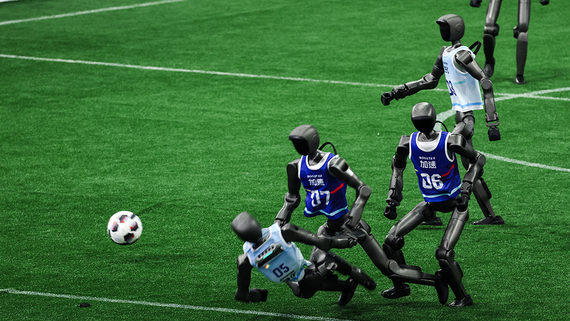
The inaugural World Humanoid Games has captured global attention as human-shaped robots from laboratories and tech companies around the world gathered to compete in athletic events that would have seemed like pure science fiction just a decade ago. The groundbreaking competition, often dubbed the “Robot Olympics,” showcased both remarkable technological achievements and amusing technical failures, highlighting just how far humanoid robotics has advanced while also revealing the significant challenges that remain before machines can truly match human physical capabilities.
The event featured dozens of humanoid robots competing in various athletic disciplines, from sprinting and walking courses to more complex challenges involving balance, coordination, and object manipulation. Engineers and roboticists from leading institutions watched nervously as their mechanical creations attempted to navigate obstacle courses, climb stairs, and perform tasks that humans accomplish without a second thought. The competition served as both a public demonstration of cutting-edge technology and a serious benchmark for measuring progress in the rapidly evolving field of humanoid robotics.
Record-Breaking Performances and Technical Mishaps
The games produced several notable records, with some robots demonstrating unprecedented speed, agility, and stability. Advanced bipedal locomotion systems allowed certain competitors to achieve walking and running speeds that would have been impossible for humanoid robots just five years ago. The improvements reflect massive investments in artificial intelligence, sensor technology, and mechanical engineering that have transformed the robotics industry. Companies like Boston Dynamics, Agility Robotics, Tesla, and numerous Chinese and Japanese firms have poured billions of dollars into developing humanoid platforms capable of working alongside humans in factories, warehouses, and eventually homes.
However, the competition also featured its share of memorable mishaps that quickly went viral on social media. Robots stumbled, fell, and occasionally froze mid-movement, providing unintentional comedy while also demonstrating the immense difficulty of replicating human movement. Walking on two legs, a skill humans master as toddlers, requires extraordinarily complex real-time calculations involving balance, momentum, and constant micro-adjustments. Even the most advanced robots struggle with uneven surfaces, unexpected obstacles, and the kind of dynamic environments that humans navigate effortlessly.
The Evolution of Humanoid Robotics
The World Humanoid Games represents the culmination of decades of research and development in robotics. The field traces its modern origins to Honda’s pioneering ASIMO robot, first unveiled in 2000, which amazed audiences by walking, climbing stairs, and even dancing. Since then, progress has accelerated dramatically, driven by advances in artificial intelligence, cheaper and more powerful computing hardware, improved battery technology, and sophisticated sensors that allow robots to perceive and respond to their environment in real time. Today’s humanoid robots can perform complex manipulation tasks, maintain balance while being pushed or walking on difficult terrain, and even execute athletic movements like backflips.
The strategic importance of humanoid robotics has not been lost on governments and major corporations. China has made humanoid robot development a national priority, with state support flowing to dozens of companies racing to create commercially viable platforms. American companies, particularly Tesla with its Optimus project, have announced ambitious plans to deploy humanoid robots in manufacturing settings within the next few years. The potential economic implications are staggering: humanoid robots that can perform physical labor could transform industries from manufacturing to elder care, potentially displacing millions of workers while also addressing labor shortages in aging societies.
Looking Toward the Future
Experts suggest that competitions like the World Humanoid Games serve a crucial function beyond entertainment. By establishing standardized benchmarks and creating public events where different approaches can be directly compared, such competitions accelerate innovation and attract talented engineers to the field. The DARPA Robotics Challenge, held in 2015, similarly spurred advances in disaster-response robotics by challenging teams to complete tasks relevant to emergency scenarios. The humanoid games continue this tradition while expanding the scope to include more athletic and dynamic movements that push the boundaries of what robots can achieve.
As humanoid robots continue to improve, questions about their role in society become increasingly urgent. The combination of advanced AI systems with capable physical platforms raises both exciting possibilities and serious concerns. Advocates envision robots that could assist elderly individuals, perform dangerous jobs, and free humans from tedious physical labor. Critics worry about job displacement, security risks, and the ethical implications of creating ever-more-human-like machines. The World Humanoid Games, with its mixture of impressive achievements and humorous failures, offers a glimpse into a future that is approaching faster than many anticipated.
Expert Opinion: The rapid advancement demonstrated at the World Humanoid Games suggests we are entering a pivotal decade for humanoid robotics. Industry analysts predict that within five years, we will see the first large-scale commercial deployments of humanoid robots in controlled industrial environments. However, the technical challenges revealed by competition mishaps indicate that general-purpose household robots remain at least a decade away, giving society crucial time to develop appropriate regulatory frameworks and workforce transition strategies.