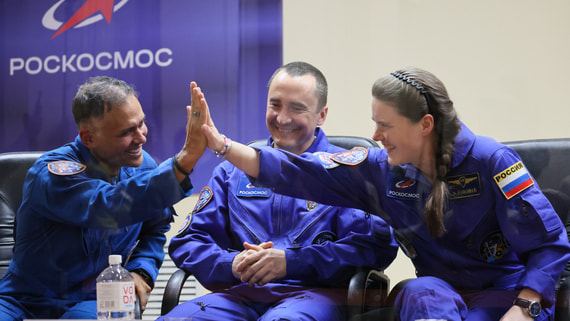
A new crew has embarked on their journey to the International Space Station as the Soyuz MS-29 spacecraft successfully lifted off from the Baikonur Cosmodrome in Kazakhstan. The mission marks another milestone in Russia’s continued participation in the ISS program, with cosmonauts preparing for an ambitious schedule that includes 38 scientific experiments and two planned spacewalks during their orbital stay. The launch proceeded smoothly, with all systems functioning nominally as the spacecraft entered its designated trajectory toward the orbital outpost.
The Baikonur Cosmodrome, the world’s first and largest operational space launch facility, has been the departure point for human spaceflight since Yuri Gagarin’s historic journey in 1961. Located in the steppes of Kazakhstan, this legendary spaceport continues to serve as Russia’s primary gateway to space, having launched hundreds of crewed missions over more than six decades of continuous operation. The facility’s infrastructure and experienced launch teams have maintained an impressive safety record for Soyuz missions, which remain one of the most reliable human-rated launch systems in the world.
Scientific Research Agenda in Orbit
The crew’s scientific program encompasses an impressive array of 38 experiments spanning multiple disciplines including biology, materials science, Earth observation, and human physiology research. These experiments are designed to take advantage of the unique microgravity environment aboard the ISS, where conditions impossible to replicate on Earth allow scientists to study phenomena ranging from crystal growth to the effects of long-duration spaceflight on the human body. The research conducted will contribute valuable data to both fundamental scientific understanding and practical applications that benefit life on Earth.
Among the planned investigations are studies examining how extended exposure to weightlessness affects cardiovascular function, bone density, and muscle mass in crew members. This biomedical research is particularly crucial as space agencies around the world prepare for longer-duration missions to the Moon and eventually Mars. Understanding and mitigating the physiological challenges of spaceflight will be essential for ensuring astronaut health and mission success on these ambitious future expeditions.
Extravehicular Activities Planned
Two extravehicular activities, commonly known as spacewalks, are scheduled as part of this mission’s objectives. These EVAs represent some of the most challenging and physically demanding work performed in space, requiring cosmonauts to exit the relative safety of the station and work in the harsh vacuum of space while protected only by their spacesuits. Spacewalks are typically conducted to perform maintenance on the station’s exterior, install new equipment, or conduct experiments that require direct exposure to the space environment.
Each spacewalk requires extensive preparation, including pre-breathing protocols to prevent decompression sickness and careful equipment checks to ensure the integrity of the Orlan spacesuits used by Russian cosmonauts. The suits themselves are remarkable pieces of engineering, essentially miniature spacecraft that provide life support, thermal regulation, and protection from the extreme temperatures and radiation of space. Cosmonauts may spend six to eight hours outside the station during a typical EVA, performing tasks that require both precision and endurance.
International Cooperation in Space
The International Space Station represents one of humanity’s greatest collaborative achievements, bringing together the space agencies of the United States, Russia, Europe, Japan, and Canada in a shared scientific endeavor. Despite geopolitical tensions on Earth, cooperation aboard the ISS has remained largely consistent, with crew members from different nations working together seamlessly in orbit. The station has been continuously inhabited since November 2000, hosting rotating crews who conduct research, maintain systems, and advance our collective knowledge of living and working in space.
The Soyuz spacecraft family has been essential to ISS operations, serving as both a crew transport vehicle and an emergency lifeboat docked at the station. Following the retirement of NASA’s Space Shuttle program in 2011, Soyuz vehicles were the sole means of transporting astronauts to and from the station until commercial crew vehicles from SpaceX began operations in 2020. Today, both Russian Soyuz and American Crew Dragon spacecraft regularly ferry international crews to the orbital laboratory, ensuring continuous human presence in low Earth orbit as the station enters its third decade of operation.
Expert Opinion: The continued successful operation of Soyuz missions demonstrates the maturity and reliability of Russian space transportation technology, even as the global space industry evolves rapidly. As the ISS partnership potentially extends into the late 2020s, maintaining robust crew rotation capabilities will be essential for maximizing the scientific return from humanity’s orbital outpost before transitioning to next-generation commercial space stations.