Magic: The Gathering Arena for Beginners: How to Start Without Wasting Wildcards
Learn Magic's basics (lands, mana, creatures, the stack, turn phases) and how Arena's wildcards, starter decks and quests work, without spending money.
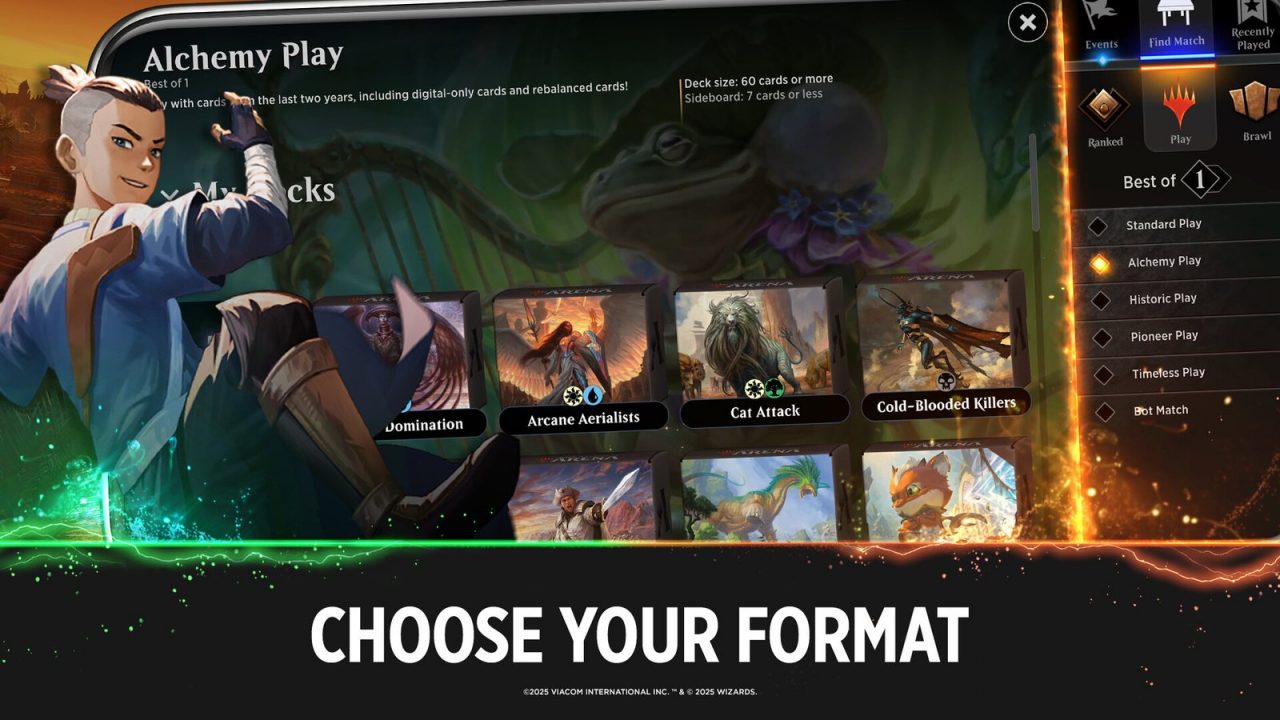
Magic: The Gathering has been around since 1993, and its digital home for most new players today is MTG Arena, Wizards of the Coast’s free-to-play client. Arena fully released on Windows on September 26, 2019, followed by macOS in 2020 and iOS and Android in March 2021. It handles every rule for you, which makes it the easiest way to learn a game with a reputation for complexity. The catch is its economy: cards are collected over time, and the most valuable resource, the wildcard, is easy to waste. This guide covers both halves: how Magic itself works, and how to grow a useful collection from free rewards.
The Basics of Magic in Plain Terms
Each player starts with 20 life. You win by reducing your opponent to zero, or, less commonly, if they have to draw from an empty library. Decks in the most common Arena formats contain at least 60 cards, with no more than four copies of any card except basic lands. You begin with a seven-card hand; if you do not like it, you can mulligan by shuffling it away, drawing seven new cards and putting one card on the bottom of your library for each mulligan you have taken.
Lands and mana
Magic’s resource is mana, and it comes mostly from lands. You may play one land per turn. Each basic land produces one mana of a color when you tap it (turn it sideways):
- Plains make white mana.
- Islands make blue mana.
- Swamps make black mana.
- Mountains make red mana.
- Forests make green mana.
A card’s cost in its top-right corner shows how much mana, and which colors, it needs. A cost of “2 plus one green” means three mana total, at least one of which must be green. Most beginner decks use one or two colors, because more colors make it harder to have the right lands at the right time. A typical 60-card deck plays somewhere around 24 lands, though the exact number depends on how expensive its cards are.
Creatures and other card types
- Creatures have power (damage dealt) and toughness (damage they can take), written like 3/2. They attack and block.
- Instants are one-off spells you can cast at almost any time, including during your opponent’s turn.
- Sorceries are one-off spells you can cast only during your own main phase when nothing else is happening.
- Enchantments and artifacts stay on the battlefield and provide ongoing effects.
- Planeswalkers are powerful allies with loyalty abilities that opponents can attack.
A creature cannot attack or use tap abilities on the turn it comes under your control. Players call this “summoning sickness.” Unlike in some digital games, damage on a creature wears off at the end of each turn, so a 3/3 that took 2 damage is back to full health next turn.
A Turn, Phase by Phase
Arena moves through the phases automatically, but knowing them explains when you can do things:
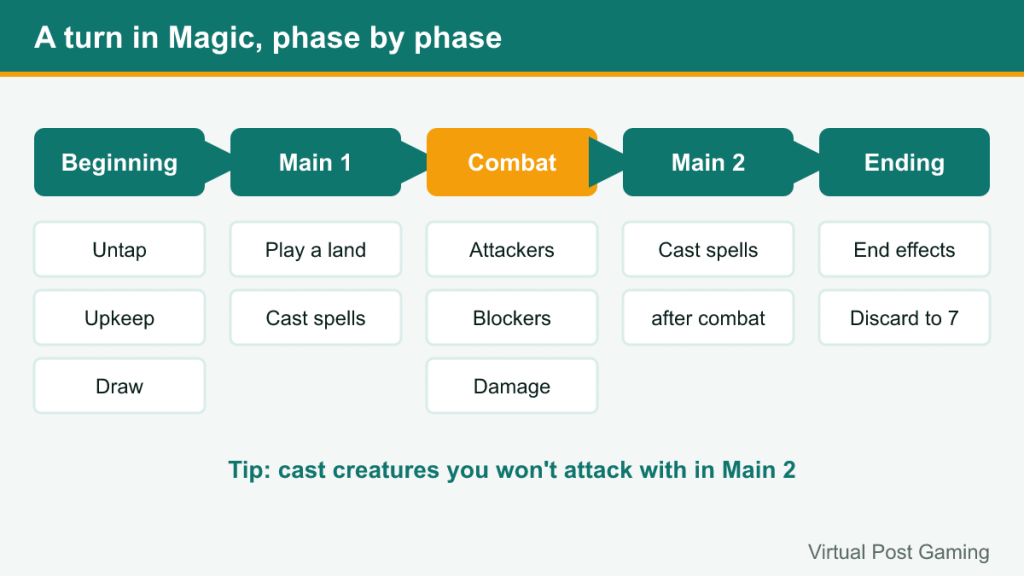
- Beginning phase: untap your permanents, then the upkeep step (some cards trigger here), then draw a card. The player who goes first skips the draw on their very first turn.
- First main phase: play a land, cast creatures and sorceries.
- Combat phase: you declare attackers, then your opponent declares blockers, then damage is dealt. Unblocked attackers damage the opponent; blocked ones fight the blocker.
- Second main phase: another chance to cast spells, useful after you have seen how combat went.
- Ending phase: end-of-turn effects happen, damage wears off, and you discard down to seven cards if needed.
A practical beginner tip: if a creature is not needed in combat, consider casting it in the second main phase. That way your opponent has less information when deciding how to block.
The Stack, Without the Jargon
The stack is Magic’s system for handling things that happen in response to each other. When you cast a spell, it does not resolve immediately. It goes onto the stack, and your opponent gets a chance to respond, for example with an instant. Then you can respond to that response, and so on. When both players pass, the stack resolves from the top down: last in, first out.
Here is a simple example. You attack with a 2/2, and your opponent blocks with a 3/3. Before damage, you cast an instant that gives your creature +2/+2. Your opponent responds with an instant that deals 2 damage to your creature. The opponent’s spell is on top, so it resolves first, and your 2/2 dies before the pump spell can save it. Your pump spell then fizzles because its target is gone.
On Arena, the stack appears as cards floating on the side of the screen, and the game shows whenever you can respond. By default it automatically passes priority in many situations; you can hold priority or adjust auto-pass settings when you want to respond at a specific moment. For a beginner, the key idea is simply that instants can interrupt things, and the most recent spell resolves first.
Arena’s Economy: Gold, Gems and Wildcards
Arena has a few currencies and resources, and understanding them is the key to building a collection without spending money:
- Gold is earned for free from daily quests and wins. It can buy booster packs and pay entry for some events.
- Gems are the premium currency, mainly bought with real money, though some events award them. This guide focuses on free resources only.
- Packs contain random cards from a set.
- Wildcards come in four rarities: common, uncommon, rare and mythic rare. One wildcard can be redeemed for one copy of any card of the same rarity.
Arena does not allow trading between players, so wildcards are the only way to get a specific card you want. You earn them from opening packs (some pack slots are replaced by wildcards, and opening packs also progresses toward guaranteed ones) and from various rewards. Duplicate commons and uncommons beyond four copies feed a Vault that pays out wildcards when opened.
Why rare wildcards matter most
Rares and mythics are the cards most competitive decks are built around, and rare and mythic wildcards arrive slowly. That makes them the real bottleneck for most free players. Spending one on a card you try for a day and abandon is the most common way new players stall their collection.
Starter Decks and the New Player Experience
New accounts begin with a short tutorial that teaches the basics. After that, the Color Challenge walks you through each of Magic’s five colors in a series of guided matches, and Wizards’ official Arena page says it unlocks 14 starter decks in total. There is also a Starter Deck Duel mode where newcomers play those decks against each other. The exact structure has changed over the years and starter deck lists refresh with Standard rotation, so treat the in-game screens as the current authority.
Starter decks serve two purposes. First, they let you play immediately while you learn the rules. Second, they show you what each color pair does: white’s small, efficient creatures, blue’s card draw and counterspells, black’s removal, red’s direct damage, green’s big creatures and mana acceleration. Playing every starter deck at least a few times is the cheapest possible way to discover which style you enjoy.
A useful detail reported by community guides: if you already own copies of cards included in a deck you receive later, you do not always get extra copies. Many players therefore suggest collecting all the free decks before opening packs or crafting.
How to Avoid Wasting Wildcards
These are the habits that experienced free-to-play players recommend most often:
- Do not craft anything at first. Play the starter decks and finish the beginner quests before redeeming a single rare wildcard.
- Pick one deck before crafting. Choose a complete decklist you want to play, ideally one built around cards you already own, and craft only toward that deck.
- Prefer cards that work in many decks. Good dual lands and flexible removal stay useful even if you change decks.
- Check the format. Standard cards rotate out over time. If you want your crafts to last, check when a card’s set leaves Standard, or choose a non-rotating format.
- Test before you craft. Arena lets you see decks and play them in casual queues; it is worth playing a deck with partial substitutions before investing in it fully.
- Avoid crafting four copies blindly. Some cards are fine as two or three copies. Do not assume every rare needs a full playset.
Free Ways to Keep Improving
Daily quests and wins
Daily quests ask you to cast spells of a certain color or win a few games. Combined with rewards for your first several wins each day, they provide a steady trickle of gold and cards. Logging in to complete quests when convenient adds up over weeks.
Play modes for learners
- Play queues (unranked) are the most relaxed place to try decks.
- Brawl uses singleton decks (one copy of each card) led by a commander, and many players find it a fun, varied way to use a small collection.
- Starter Deck Duel pits the free starter decks against each other, so nobody has a collection advantage.
- Bot drafts and other Limited events let you build decks from cards you open during the event. They cost entry fees, but they teach evaluation skills quickly and can return rewards.
Learning resources
Wizards’ own pages explain card types and rules, and the in-game tooltips define every keyword. If you have played Hearthstone, much of the basic structure will feel familiar, though Magic’s land system and instant-speed interaction are major differences; our Hearthstone beginner’s guide is useful for comparison. And if you are wondering why Magic is a “collectible” game rather than a deckbuilder, see our explainer on what a deckbuilder is.
Common Beginner Mistakes
- Too few lands. Cutting lands to fit in more spells leads to hands where you cannot cast anything. When in doubt, keep the land count the deck was built with.
- Too many colors. Three- and four-color decks need special lands to work. Stick to one or two colors at first.
- Attacking into obvious blocks. Before attacking, look at what your opponent can block with and what tricks their untapped mana might represent.
- Ignoring the opponent’s open mana. If an opponent leaves mana untapped during your turn, they may have an instant ready.
- Clicking through the stack. When Arena pauses to give you priority, read what is happening before passing.
Magic rewards patience in two ways: patience during a game, when you wait for the right moment to use a spell, and patience with your collection, when you wait until you know exactly what you want before crafting. Master both and Arena becomes a deep, sustainable hobby that does not require spending to enjoy.