CCG, TCG, LCG, Deckbuilder: Card Game Categories Explained
What separates a CCG, a TCG, an LCG and a deckbuilder? Clear definitions, constructed vs limited formats, digital differences and a comparison table.
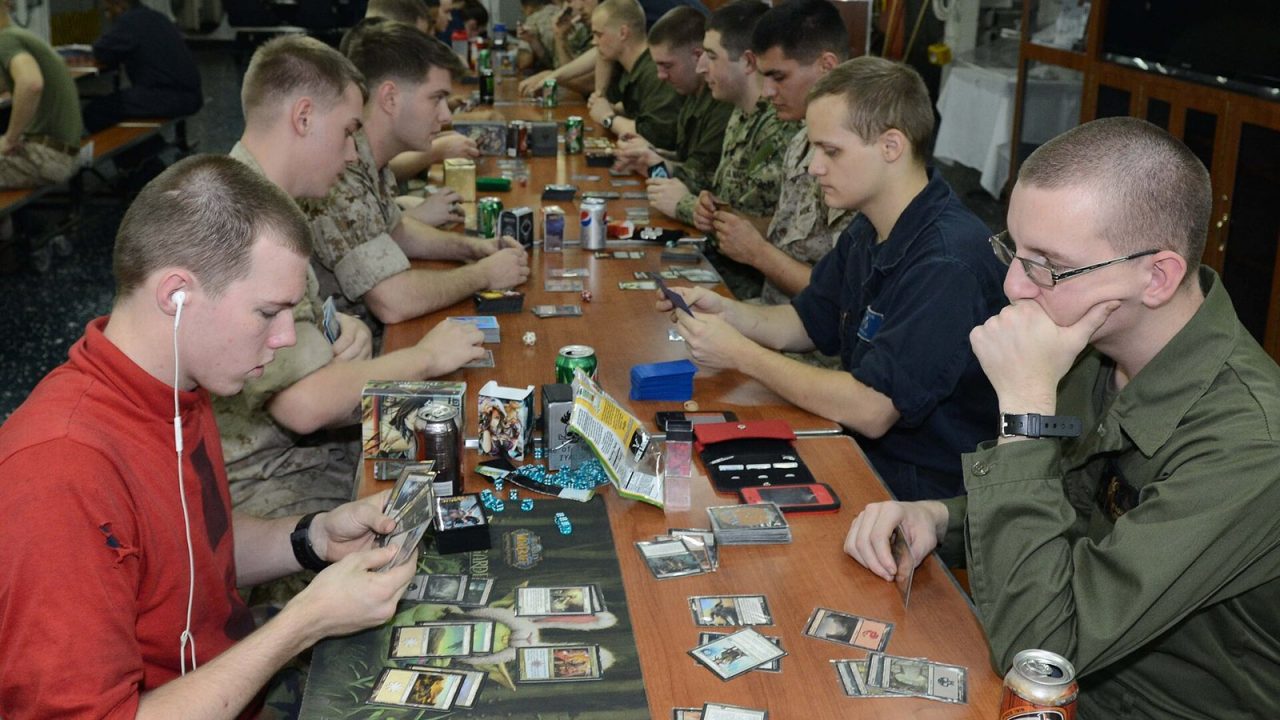
Card game players love abbreviations, and the ones describing the games themselves are some of the most confusing. Is Hearthstone a CCG or a TCG? Is Slay the Spire a deckbuilder in the same sense as Dominion? What exactly is “living” about a Living Card Game? The categories overlap, and marketing departments have blurred them further. This guide sets out what each term usually means, how formats like constructed and limited cut across all of them, and what changes when a card game moves onto a screen.
Collectible Card Games (CCGs)
A collectible card game is one where each player builds a personal collection of cards over time and constructs decks from it. The classic CCG model has three features:
- Randomised distribution. Cards are mostly sold in sealed booster packs with unknown contents, so no two collections are identical.
- Rarity. Some cards are printed in smaller quantities than others, making them harder to find.
- Ongoing expansions. New sets keep arriving, adding new cards and strategies.
The genre began with Magic: The Gathering, designed by Richard Garfield and published by Wizards of the Coast, which premiered at the Origins Game Fair in 1993. Magic is generally recognised as the first CCG, and its success led a wave of other publishers to launch their own in the following years.
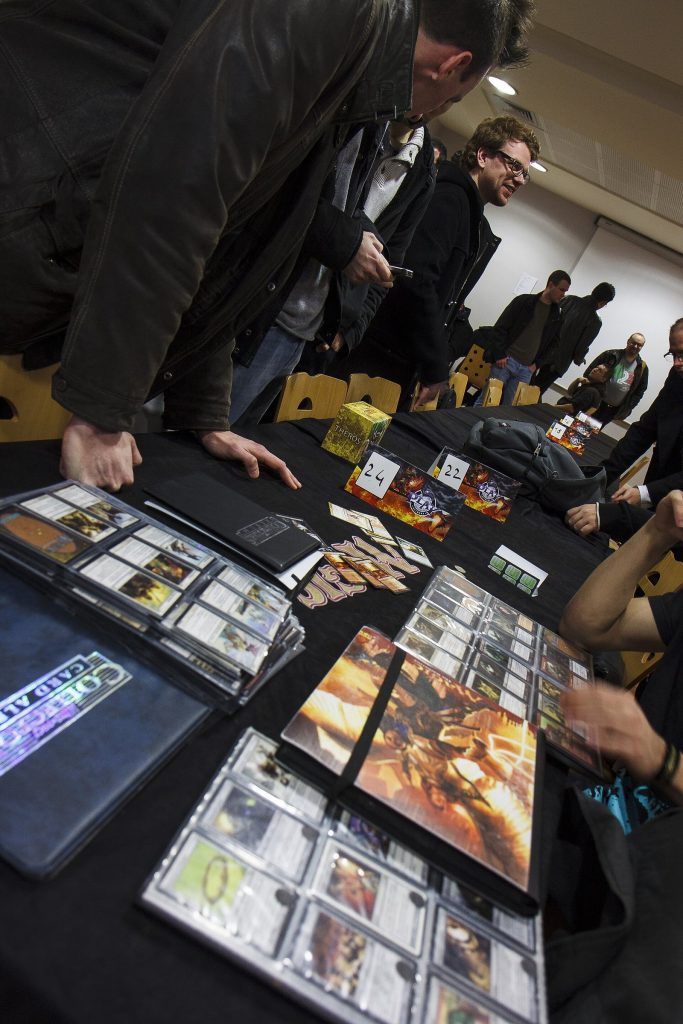
The defining idea is that the collection is separate from the game. You play with a deck drawn from your collection, but building and maintaining that collection happens between games, through buying, opening, trading or earning cards.
Trading Card Games (TCGs): A Different Name for the Same Thing
“Trading card game” is, for practical purposes, a synonym. The two terms are used interchangeably, and which one a publisher picks is largely a matter of branding and trademark history. Magic usually calls itself a trading card game; other games prefer “collectible.” Some reference works list further names as well, such as “customizable card game” and “expandable card game.”
If there is a shade of difference, it is in emphasis. “Trading” highlights the social and secondary-market side: players swapping cards with friends or buying and selling singles. “Collectible” puts the focus on assembling a collection. In physical play, both describe the same kind of product.
Where the distinction becomes real is in digital games, as we will see below, because many digital “collectible” games do not allow trading at all.
Living Card Games (LCGs): Fixed Contents, No Randomness
Living Card Game is a term trademarked by Fantasy Flight Games for a different distribution model. LCGs keep the expandable, deck-construction side of a CCG but remove random packs:
- A core set contains a fixed, known set of cards, often enough for two players.
- Expansions, historically small packs released on a regular schedule plus larger “deluxe” boxes, also have fixed, published contents.
- Expansion packs typically include enough copies of each card to reach the deck-building limit, so you never need to buy duplicates.
The result is that anyone who buys a particular product owns exactly the same cards as everyone else who bought it. There is no chase for rare cards and no need to trade. The “living” part refers to the game continuing to grow through expansions rather than staying a closed box.
Well-known LCGs include The Lord of the Rings: The Card Game (2011), Android: Netrunner (2012, discontinued in 2018), Arkham Horror: The Card Game (2016) and Marvel Champions: The Card Game (2019). Several of the most popular are cooperative, with players working together against a scenario rather than against each other, which is a design space CCGs rarely explore.
Expandable card games and other close relatives
Other publishers have used similar non-random models under their own names, and some board games come with fixed decks that receive expansions. When you see “expandable card game” or similar labels, check how the product is sold: if contents are fixed and known, it works much like an LCG, whatever it is called.
Deckbuilders: Building the Deck During Play
A deckbuilder is a completely different category. Instead of assembling a deck before the game from a personal collection, everyone starts the game with a small, identical or near-identical deck and builds it up during play, adding cards from a shared market or from rewards.
The tabletop genre began with Dominion, designed by Donald X. Vaccarino and published by Rio Grande Games in 2008. Everything needed to play is in the box; no collection carries over between games. The digital branch, the roguelike deckbuilder, was popularised by Slay the Spire (full release 2019), where a single run is the game and your deck grows through card rewards after each fight.
The confusion comes from everyday speech. People often say “deckbuilding” to mean “constructing a deck for Magic or Hearthstone,” which is accurate English but not the genre label. When someone recommends “a good deckbuilder,” they nearly always mean a game like Dominion or Slay the Spire, not a CCG. We go deeper into the genre in what a deckbuilder is.
Formats: Constructed and Limited
Category tells you how a game’s cards are distributed. Format tells you how a particular game session is built. Two broad families apply to CCGs and many LCGs.
Constructed
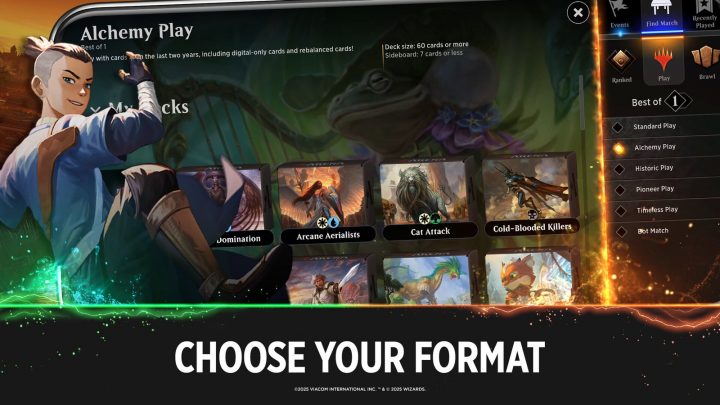
In constructed formats, players bring decks they built in advance from their collections, following deck-building rules such as minimum deck size and maximum copies per card. Many games have multiple constructed formats that differ in which sets are allowed. Magic’s Standard format uses recent sets, while larger formats allow older cards; Hearthstone has its own Standard and Wild split for the same reason.
Limited
In limited formats, players build decks on the spot from a restricted pool of cards provided for that event:
- Sealed: each player opens a set number of packs and builds a deck from those cards alone.
- Draft: players open packs and take turns picking one card and passing the rest, building a pool from which they then make a deck.
- Arena-style drafts: some digital games let you pick from small random choices to build a deck for a run of matches, as in Hearthstone’s Arena mode.
Limited formats are interesting because they borrow a little from deckbuilders: deck construction becomes part of the event and everyone starts on equal footing, without a collection advantage. The difference is that the deck is still locked before the matches begin.
How Digital Versions Change Collecting and Trading
Moving card games online changes the economics, sometimes dramatically.
Trading may disappear
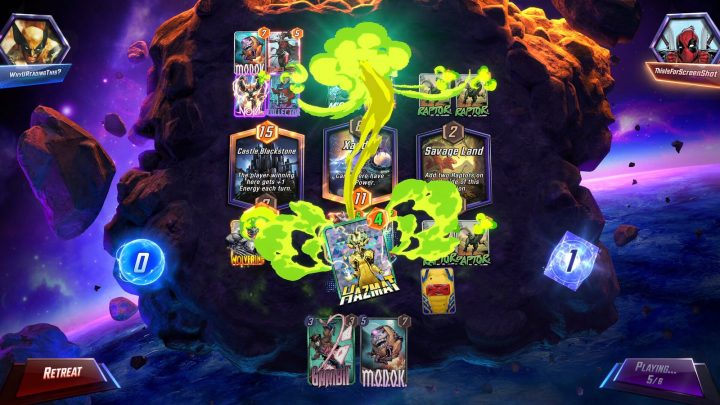
Magic: The Gathering Online, launched in 2002, allows players to trade digital cards with each other. Most newer digital card games do not. MTG Arena, Hearthstone and Marvel Snap all keep cards tied to your account with no player-to-player trading. That means they are digital collectible games, but not really “trading” games in the original sense.
Crafting replaces the secondary market
Instead of trading, digital games usually offer a crafting system. In Hearthstone, unwanted cards are disenchanted into Arcane Dust that can craft specific cards. In MTG Arena, wildcards can be redeemed for any card of matching rarity, as explained in our MTG Arena beginner’s guide. These systems let players target cards they need without trading.
Packs are not the only route
Some digital games abandon traditional packs almost entirely. Marvel Snap, for instance, unlocks cards mainly through its Collection Level and series system, as covered in our Marvel Snap explainer. Free rewards tracks, quests and seasonal passes are common across the genre.
Digital-only design
Digital games can do things physical cards cannot: create random cards from nothing, track hidden information perfectly, change card text with balance patches, and enforce complex rules automatically. Some formats lean into that; others try to stay close to the paper experience.
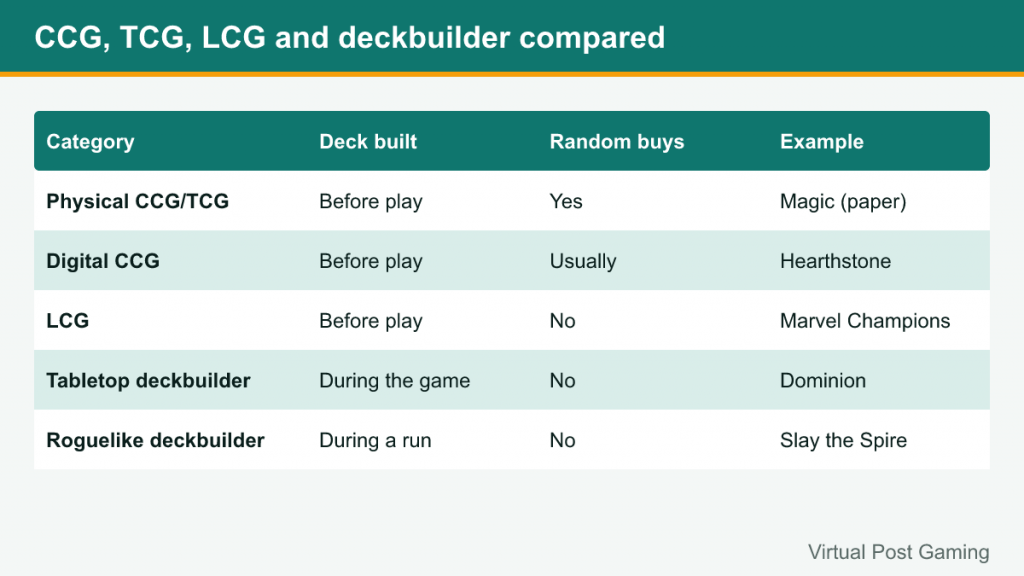
Comparison Table
| Category | When is the deck built? | How are cards obtained? | Randomness in purchases | Examples |
|---|---|---|---|---|
| CCG / TCG (physical) | Before play, from your collection | Booster packs, singles, trading | Yes | Magic: The Gathering |
| Digital CCG | Before play, from your account’s collection | Packs, rewards, crafting; often no trading | Usually | Hearthstone, MTG Arena, Marvel Snap |
| LCG | Before play, from fixed products | Core sets and fixed expansions | No | Arkham Horror: The Card Game, Marvel Champions |
| Tabletop deckbuilder | During the game | Bought from a shared market each game | No (all in the box) | Dominion |
| Roguelike deckbuilder | During a run | Rewards, shops and events within the run | No (cards come from play) | Slay the Spire, Balatro |
Common Mix-Ups
“Hearthstone is a deckbuilder”
Casually, people say this all the time. Technically, Hearthstone is a digital collectible card game: you build decks from a collection before play. Its Arena mode is a draft format, but even that locks the deck before matches.
“An LCG is just a CCG with fewer cards”
The card pool can be huge. What defines an LCG is how cards are sold, not how many exist.
“TCG means you can sell your cards”
In physical games, usually yes. In most modern digital games, no. The label often survives from the paper version even when trading does not exist in the app.
“Balatro isn’t a deckbuilder because it uses a normal deck”
Balatro modifies its deck and Jokers during the run, which is exactly what deckbuilders do. Using standard playing cards does not change the genre.
Which Category Suits You?
- If you love collecting and long-term deck tinkering, a CCG (physical or digital) is the natural home.
- If you want deep deck construction without random packs, an LCG gives you that with predictable products.
- If you prefer everything to happen inside a single session, with no collection to maintain, a deckbuilder is the cleanest fit.
- If you want equal footing in a competitive card game, look for limited formats such as draft and sealed.
The labels are imperfect, but they answer one useful question each: when do you build your deck, and where do your cards come from? Once you ask that, almost any card game falls neatly into place.