Slay the Spire 2 Explained: Characters, Co-op and What Changed from the Original
Slay the Spire 2 as of 2026: the early access launch, the five characters including Necrobinder and Regent, four-player co-op, the Godot engine and what changed.
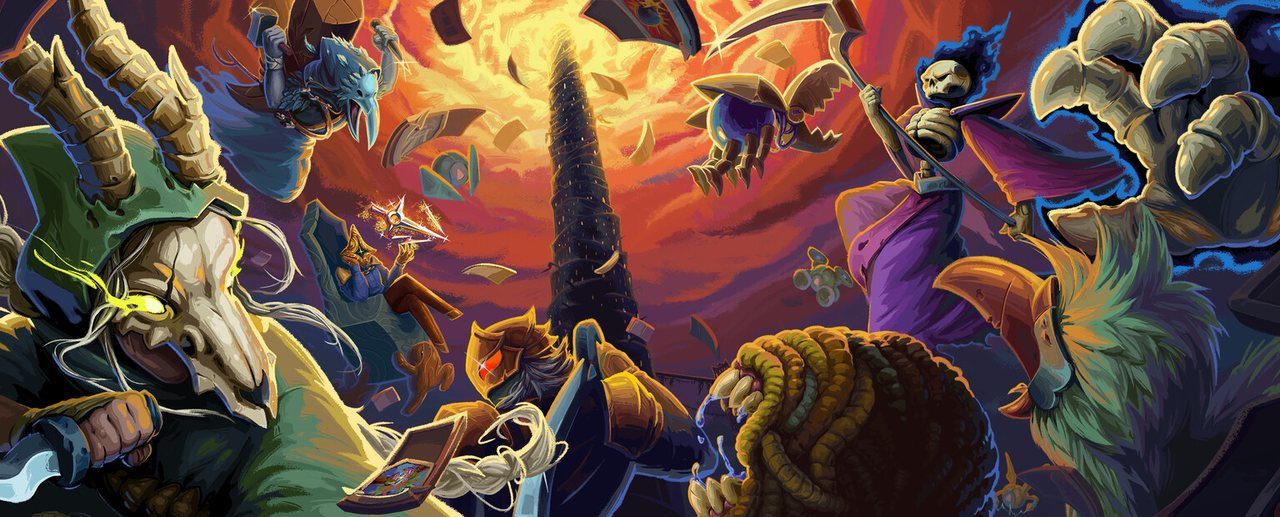
Slay the Spire did more than any other game to turn the roguelike deckbuilder into a genre of its own. So when Mega Crit announced a sequel, the question for fans was not whether it would sell, but how much it would change. Would it be the same game with new cards, or something that rethought the formula?
This guide explains what Slay the Spire 2 is as of October 2026: how it came to be, which characters are playable, how the new co-op mode works and what is different from the original. Because the game is in early access and still changing, it sticks to features confirmed by Mega Crit’s Steam page and well-documented coverage, and it avoids balance details that are likely to shift between patches.
From Announcement to Early Access
Mega Crit announced Slay the Spire 2 in April 2024, with early access then planned for 2025. The studio, which develops and publishes the game itself, later delayed the launch, explaining that it wanted the early access version to meet its quality standards. The game entered Steam Early Access on March 5, 2026, for Windows, macOS and Linux, including SteamOS.
The launch was a major event for the genre: the game passed 177,000 concurrent players on Steam on its first day, a sign of how much the first game had grown its audience since its full release in January 2019.
How long early access is expected to last
On the Steam page, Mega Crit estimates that early access will last roughly one to two years. The studio lists additional content, a true ending, more game modes, balance improvements, bug fixes, broader hardware support, enhanced visual effects and more languages among its plans for the full release. It also states that the price will rise after early access. As of October 2026, no full release date has been announced, and console versions have not been confirmed.
The Engine Change
One of the most discussed parts of the sequel’s development happened behind the scenes. Slay the Spire 2 began development in Unity. In September 2023, Unity announced a runtime fee policy that was widely criticized by developers; although the company later reversed course, Mega Crit decided to move the project to the open-source Godot engine, rebuilding roughly two years of work in the process.
For players, the switch is mostly invisible. Its practical effects show up in the game’s support for multiple platforms and in the studio’s long-term independence from a commercial engine’s licensing terms. It also made Slay the Spire 2 one of the highest-profile commercial games built on Godot.
The Characters
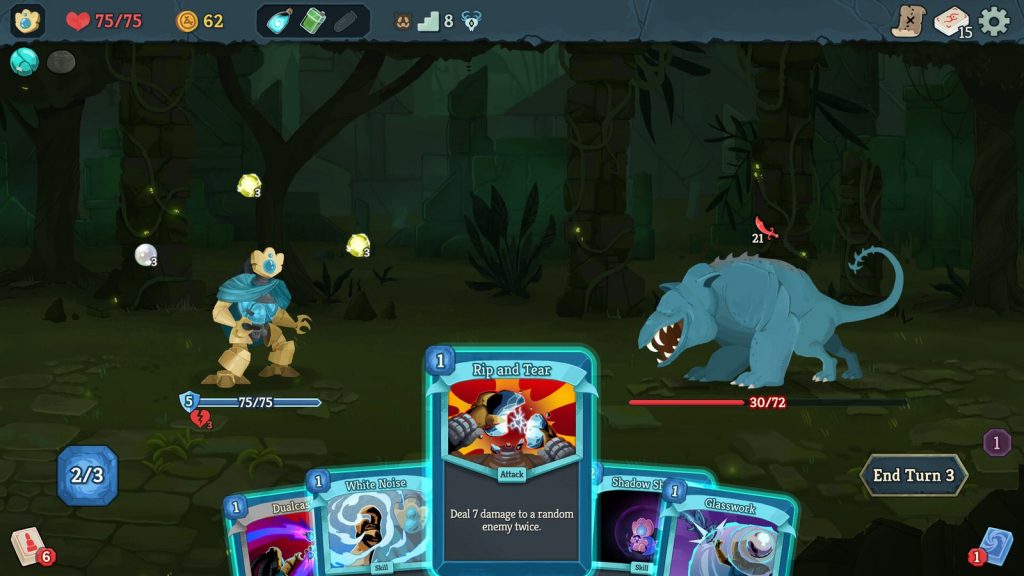
At the start of early access, Slay the Spire 2 has five playable characters: three returning from the original and two new ones. According to Mega Crit, more are planned as development continues.
Returning: Ironclad, Silent and Defect
The Ironclad, Silent and Defect come back with the core identities they had in the first game. The Ironclad remains a durable warrior built around strength and raw power, the Silent is a huntress who uses daggers and poison, and the Defect is a robot that channels elemental orbs. Their card pools have been reworked for the sequel, so players should not expect identical cards or identical strategies, even when the character feels familiar.
The Watcher, the fourth character of the original game, was not part of the early access roster at launch.
New: the Necrobinder
The Necrobinder is a lich accompanied by Osty, a large skeletal hand that acts as a companion. Osty can attack enemies and shield the Necrobinder from incoming damage. Having a second body on your side of the battlefield introduces decisions that did not exist in the first game, such as when to protect the companion and when to spend it as a resource.
New: the Regent
The Regent introduces a second resource called stars, used and managed alongside energy by many of his cards, and he can forge a weapon known as the sovereign blade. A second resource changes how hands are evaluated: a card might be cheap in energy but demand stars, so building the deck around both pools is part of the challenge.
For the basics of how a run is structured, start with our Slay the Spire beginner’s guide, which applies to the original but explains the shared foundations.
Co-op: Climbing Together
The headline new feature is online co-op for up to four players. Each player chooses a character and takes their own cards, health and resources into a shared climb. Fights involve the whole team, and many effects let allies help one another by healing, defending, buffing or debuffing.
The co-op rules include several important adjustments:
- Tougher enemies. Enemies have more health in co-op, and their attacks hit all players rather than one.
- Revival. A player who falls in combat is revived with one hit point after the fight, so one bad turn does not remove them from the run.
- Shared failure. The run ends only if every player falls.
- Co-op content. Mega Crit describes multiplayer-specific cards and team synergies, so co-op is more than four separate single-player games running side by side.
Co-op changes the strategic picture. In single-player, every card must serve your own survival; in co-op, one player can build heavily into defense or support while another focuses on damage. Communication matters, because a team that plans who handles which enemy will usually do better than four players acting alone.
What Else Changed from the Original
The map and alternate acts
The basic structure is familiar: each act is a map with branching paths of combat, events, rest sites and shops leading to a boss. The sequel adds alternate acts. Each act exists in two versions with their own environments, enemies, events and bosses, and the game picks one at random for each run. That increases variety, since two runs may pass through quite different places even with the same character.
Combat fundamentals
Combat keeps the elements that made the first game work: a limited amount of energy each turn, enemies that telegraph their intentions, and cards that attack, block, buff and debuff. Players who know the original will feel at home within minutes. The differences lie in the details of cards, relics and enemies rather than the core loop.
Shops and rest sites
As before, shops let you buy cards, potions and relics, and remove cards from your deck, and rest sites offer recovery or improvement. The reasoning behind thinning a deck and choosing fights carefully carries over directly. Our guide to drafting in roguelike deckbuilders covers those principles in a way that applies to both games.
The timeline
Slay the Spire 2 adds a metagame feature that presents the history of the Spire and how the characters came to it. Completing runs and meeting certain goals unlocks entries in this timeline, along with characters and features. It gives progression a narrative frame that the original, which relied mostly on unlock bars per character, did not have.
Original vs Sequel at a Glance
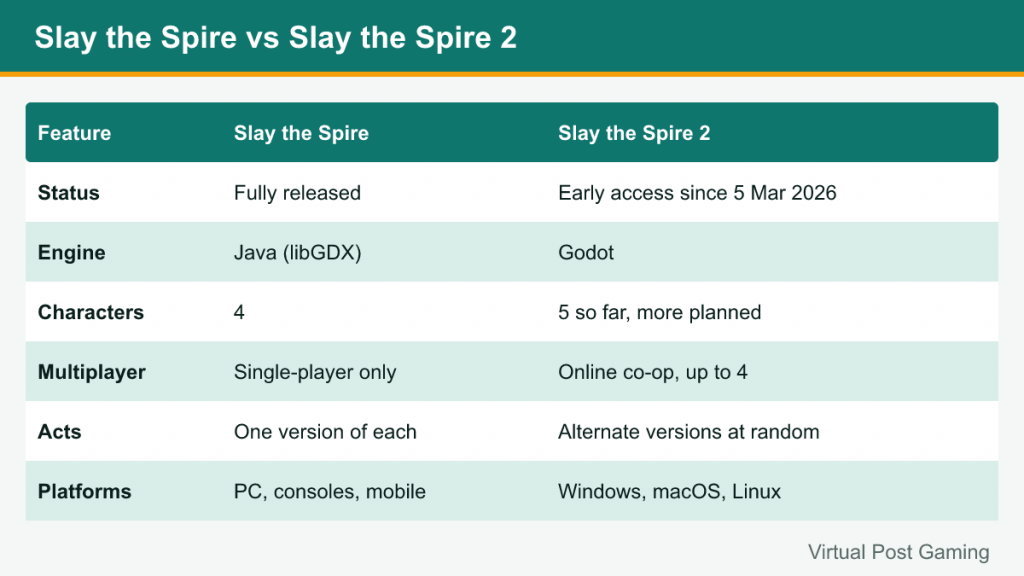
| Feature | Slay the Spire (2019) | Slay the Spire 2 (early access, 2026) |
|---|---|---|
| Status | Fully released | Early access since March 5, 2026 |
| Engine | Java-based libGDX framework | Godot |
| Characters | Ironclad, Silent, Defect, Watcher | Ironclad, Silent, Defect, Necrobinder, Regent (more planned) |
| Multiplayer | Single-player only | Online co-op for up to four players |
| Acts | One version of each act | Alternate versions of acts chosen at random |
| Platforms | PC, consoles and mobile | Windows, macOS, Linux/SteamOS |
Should You Play the Original First?
It is not necessary. Slay the Spire 2 teaches its own systems, and new players can start there. That said, there are good reasons to try the original:
- It is complete. The original has a finished set of characters, acts and the high-level Ascension system, while the sequel’s content is still growing.
- It is widely available. The first game is available on more platforms, including consoles and phones.
- Its knowledge transfers. Concepts like reading intents, balancing damage and block, removing basic cards and building scaling all apply directly.
Players who enjoy being part of a game’s development, sharing feedback and seeing balance shift between patches will find early access rewarding. Players who prefer a polished, finished experience may want to wait for the full release, or play the original in the meantime.
Things to Keep in Mind During Early Access
- Balance changes frequently. Cards and relics can be adjusted between patches, so strategies that work today may not work next month.
- Content is incomplete. Mega Crit has said a true ending and further modes are among its plans for the full release.
- Feedback is part of the process. Early access exists so the studio can learn from players. Constructive reports through official channels help more than complaints elsewhere.
- Check the patch notes. Before relying on a guide or video, check when it was made and what has changed since.
Frequently Asked Questions
Is co-op required?
No. Single-player remains the core of the game. Co-op is an additional way to play.
Does co-op work across platforms?
The early access version is on Steam for Windows, macOS and Linux, and co-op is online. Check the Steam page for current details before planning a group session.
Will the Watcher return?
Mega Crit has said more characters are planned, but as of October 2026 the Watcher is not in the game, and the studio has not confirmed which characters will be added.