Card Game Fundamentals: Mana Curve, Card Advantage and Tempo
The three ideas behind almost every card game decision: mana curve, card advantage and tempo, with worked examples from Magic and Hearthstone.
Card games differ in their details, but strong players in Magic: The Gathering, Hearthstone and most of their relatives think in the same three terms. They ask whether their deck can use its mana efficiently each turn, whether they are ending up with more useful cards than their opponent, and whether they are ahead on the board right now. Those questions map to three concepts: mana curve, card advantage and tempo.
This guide explains each concept with worked examples, shows how they pull against one another and suggests ways to use them when building and playing a deck. The ideas are game-agnostic; examples come from Magic and Hearthstone because those games share the resource model that made the vocabulary popular.
The Shared Foundation: Resources Over Time
Most competitive card games ration resources in two ways. First, there is a per-turn resource, usually called mana or energy, that grows over the game. In Hearthstone, each player gains a mana crystal every turn up to a maximum of ten. In Magic, players normally play one land per turn, so available mana also climbs gradually. Second, there are the cards themselves: you start with a hand and draw more over time.
Almost every strategic decision is about converting those two resources into a winning position. Curve is about spending mana well. Card advantage is about the number of cards. Tempo is about how quickly your resources become pressure on the board. If you have read our beginner guides to Hearthstone or MTG Arena, these are the concepts that sit one step beyond the basic rules.
Mana Curve: Having Something to Do Every Turn
The mana curve is the distribution of mana costs in your deck. Deckbuilders usually picture it as a bar chart: how many cards cost one, how many cost two, and so on up to the expensive cards. The word “curve” comes from the shape of that chart.
The reason it matters is simple. Mana you do not spend is wasted for that turn. If your deck is full of five-cost cards, your first four turns will often be empty. If it is full of one-cost cards, you will run out of things to play by the middle of the game and your cards will be weaker than the opponent’s expensive ones.
Playing on curve
“Playing on curve” means using a card whose cost matches the mana you have that turn: a two-cost card on turn two, a three-cost card on turn three and so on. A player who plays on curve for the first several turns usually builds a strong board, because they have used every point of mana available. A player who misses a turn early often falls behind in a way that is hard to recover from.
A worked example
Imagine two players in a Hearthstone-style game. Player A has a two-cost, a three-cost and a four-cost minion in hand. Player B has two five-cost minions and a one-cost spell. By the end of turn four, Player A has spent nine mana and has three minions on the board. Player B has spent at most one mana and has no board. Even if Player B’s later cards are individually stronger, Player A’s head start may decide the game.
Building a curve
- Count your early plays. Make sure the deck has enough cheap cards to act in the first turns.
- Match the curve to the deck’s plan. Aggressive decks concentrate on low costs; slower decks can afford more expensive cards because they plan to survive until they can cast them.
- Consider flexible cards. Cards that are useful at different points of the game, or that combine with other cheap cards on the same turn, smooth out awkward hands.
- In Magic, include enough lands. The curve only works if you reliably hit your land drops. A deck with a high curve needs more mana sources.
Card Advantage: More Useful Cards Than Your Opponent
Card advantage is a measure of resources in the long run. If you end up with more cards (in hand and on the battlefield) than your opponent, you usually have more options and more power. The idea is old in Magic strategy and translates to almost every card game.
The common shorthand is “X-for-1.” If one of your cards removes two of the opponent’s cards, that is a two-for-one: you spent one card and they lost two. If you trade one card for one card, nobody gains.
Ways to gain card advantage
- Drawing extra cards. Hearthstone’s Arcane Intellect draws two cards. Magic’s Divination does the same. You spend one card and get two back, ending up one card ahead.
- Removing multiple threats with one card. Board-clearing spells such as Magic’s Wrath of God or Hearthstone’s Flamestrike can destroy several enemy creatures at once.
- Favorable trades in combat. If one of your creatures blocks or attacks and destroys two smaller enemies over time while surviving, it has generated card advantage.
- Using non-card resources. Hearthstone hero powers, for example, can finish off a damaged minion without spending a card.
Virtual card advantage
Not every card in hand is useful. A removal spell with no targets, or a card that cannot be cast, is effectively dead. Players call it virtual card advantage when your opponent’s cards become useless because of the game state. For instance, if your deck plays very few creatures, the opponent’s creature removal sits uselessly in their hand. Counting live cards rather than raw cards gives a more accurate picture of who is ahead.
A worked example
Your opponent has played three small creatures over three turns. You cast a single board-clearing spell that destroys all of them. You spent one card; they lost three. Even if their board had been threatening, you are now up two cards, and in a long game that extra material usually matters.
Tempo: Winning the Race Right Now
Tempo is the hardest of the three to define precisely, which is why players use it in slightly different ways. A practical definition is: how efficiently your actions turn mana into board impact, and how much they set the opponent back. Tempo is about the short term, the next few turns, where card advantage is about the whole game.
A tempo play typically costs less than the effect it creates, or forces the opponent to waste a turn. Examples include:
- Cheap removal on an expensive threat. Killing a five-cost creature with a one-cost spell means you spent one mana to erase five of theirs.
- Bounce effects. Magic’s Unsummon returns a creature to its owner’s hand; Hearthstone’s Sap does the same with a minion. No card is destroyed, so card advantage is unchanged, but the opponent must spend mana and a turn to replay it.
- Immediate impact. Creatures that attack the turn they enter play, or minions with Rush or Charge in Hearthstone, convert mana into pressure faster than ordinary creatures.
- Mana acceleration. Effects that give extra mana early let you play threats ahead of curve, which is a tempo gain if the extra mana is actually used.
A worked example
You attack with two creatures each turn while your opponent tries to stabilize. On their turn they cast a big blocker. You spend one mana to bounce it back to their hand and keep attacking. Next turn they must spend their whole turn replaying the blocker while you add another threat. You have not gained cards, but you have gained time, and time is what an aggressive deck needs.
How the Three Concepts Trade Off
The reason these concepts are worth learning together is that they compete. Many decisions are a trade between them.
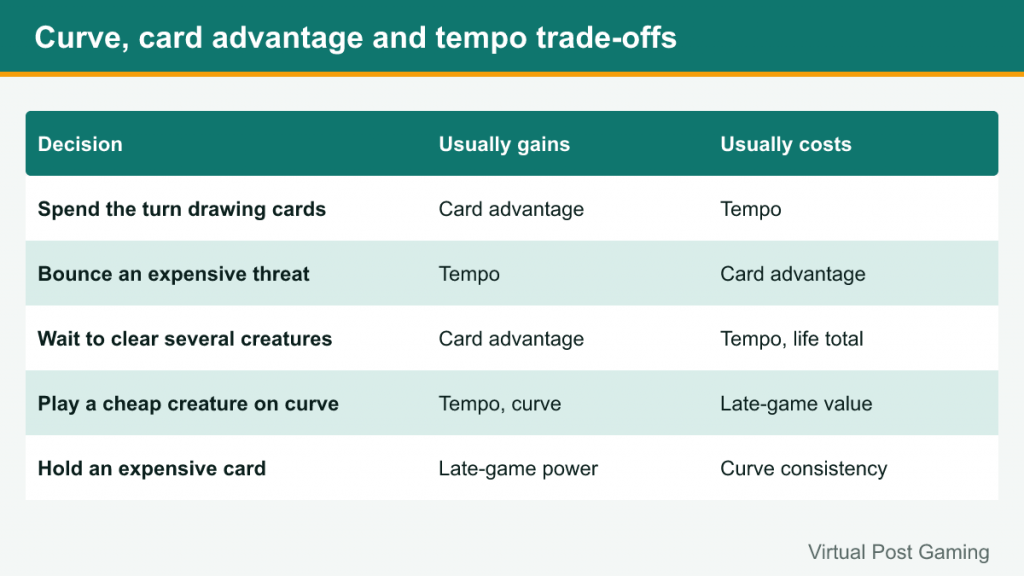
| Decision | Usually gains | Usually costs |
|---|---|---|
| Spend your turn drawing cards | Card advantage | Tempo (nothing added to the board) |
| Bounce an expensive threat | Tempo | Card advantage (the card is not destroyed) |
| Wait to clear several creatures at once | Card advantage | Tempo and life total while you wait |
| Play a cheap creature on curve | Tempo and curve efficiency | Possibly weaker late-game value |
| Hold an expensive card in a low-cost deck | Late-game power | Curve consistency |
Aggressive decks typically prioritize tempo and curve. They aim to win before card advantage matters. Control decks prioritize card advantage, accepting early tempo losses in exchange for overwhelming the opponent later. Midrange decks sit between, trying to be slightly faster than control and slightly more powerful than aggro.
A useful question during any game is: “If this game goes long, who wins?” If the answer is your opponent, you should lean into tempo and pressure. If the answer is you, you can afford to trade tempo for card advantage and safety.
Applying the Concepts When Building a Deck
- Decide on your plan first. Is this deck trying to win early, survive and outvalue, or assemble a combination? The plan determines which concept comes first.
- Draw the curve. List cards by cost and check that you have plays in the early turns appropriate to your plan.
- Count your card advantage sources. Slower decks need ways to refill their hand or remove multiple threats.
- Count your tempo tools. Faster decks need efficient threats and cheap interaction.
- Cut cards that serve no plan. A card that is slow and gives no card advantage rarely belongs anywhere.
Applying the Concepts While Playing
During a game, a short checklist helps more than any rule of thumb:
- Can I use all my mana this turn? If not, is there a good reason, such as holding a reactive card?
- Is this trade one-for-one, or better? Look for plays that remove more than one card or keep your creature alive.
- Am I ahead or behind on board? If behind, prioritize catching up; if ahead, press the advantage before the opponent stabilizes.
- What does the opponent’s deck want? Slow down a tempo deck; pressure a control deck before its card advantage takes over.
Common Mistakes
Valuing card advantage in every matchup
Drawing cards is useless if you are dead before you can play them. Against a fast deck, a card that stabilizes the board now is often worth more than two cards later.
Holding cards for a perfect moment
Waiting for a two-for-one can cost you several turns of unused mana. Sometimes the efficient one-for-one now is better than the ideal play that never arrives.
Ignoring the curve in deckbuilding
Many new decks are packed with powerful expensive cards and lose because they do nothing early. A slightly weaker card that fits the curve frequently improves the deck overall.
Confusing tempo with aggression
Tempo is about efficiency, not just attacking. A control deck that answers a threat with a cheap spell has gained tempo even if it never attacks.
These ideas also apply beyond traditional collectible games. Roguelike deckbuilders and other card games use energy instead of mana and build decks during play, but the same tensions appear; our guide to card game categories explains how those genres relate.