Hearthstone for Beginners: Mana, Heroes, Minions and Your First Decks
A plain-English guide to Hearthstone: how mana and turns work, what minions, spells and keywords do, and how to start with free decks.
Hearthstone has been around since March 2014, when Blizzard Entertainment released it on Windows and macOS, and it has picked up a lot of mechanics, modes and menus along the way. The good news for a newcomer is that the core rules are still compact. Once you understand mana, the board and a dozen common keywords, every other card is just a variation on ideas you already know. This guide covers how a game works, what you are looking at on the board, and how to get your first playable decks using the free tools the game provides.
The Goal and the Basic Setup
Each player controls a hero with 30 health. You win by reducing the opposing hero to zero. You do that with a 30-card deck built for one of Hearthstone’s classes. As of 2026 there are eleven: Death Knight, Demon Hunter, Druid, Hunter, Mage, Paladin, Priest, Rogue, Shaman, Warlock and Warrior. Your deck can contain cards specific to your class plus neutral cards that any class can use.
At the start of a game, a coin flip decides who goes first. The first player draws three cards and the second draws four, plus a special card called The Coin, which gives one temporary extra mana crystal for a single turn. Both players can then mulligan: swap out any of their opening cards for new ones from the deck. Most beginners keep too many expensive cards; a good habit is to throw back anything you could not play in the first three turns.
Mana: The Resource Behind Every Turn
Every card has a mana cost in its top-left corner. You start with one mana crystal and gain another at the beginning of each of your turns, up to a maximum of ten. Your crystals refill every turn, so on turn five you have five mana to spend, on turn six you have six, and so on.
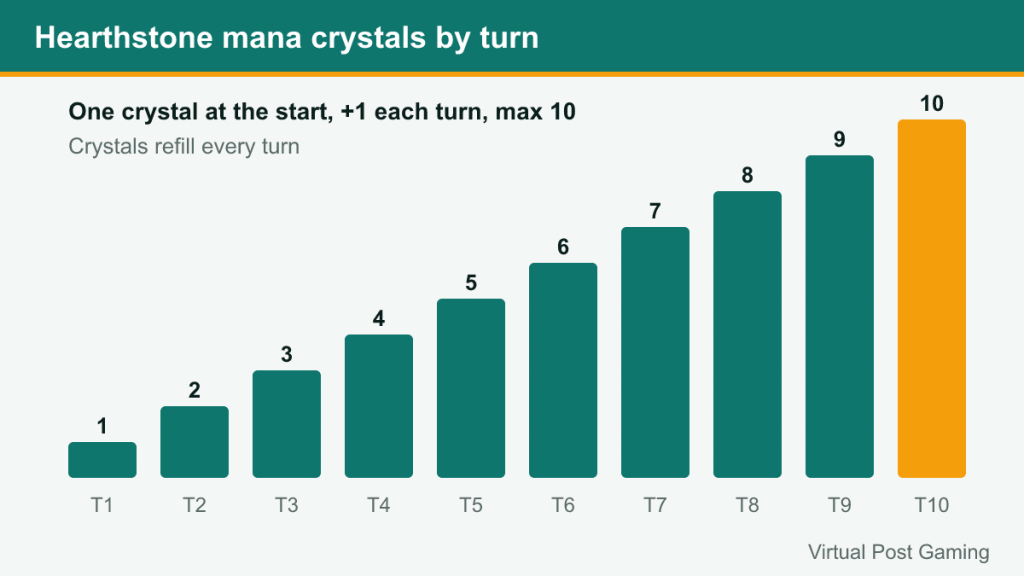
This creates the basic rhythm of Hearthstone: cheap cards early, expensive cards later. If your deck is full of six-cost cards, you will spend the first five turns doing very little while your opponent builds a board. Spreading costs so that you have something useful to do each turn is called building a good mana curve, and it is the first thing to check when a deck feels clunky.
Some cards have Overload, which locks some of your mana crystals on your next turn as a cost for a strong effect now. A few effects also give you temporary or permanent extra crystals, which is the basis of “ramp” strategies.
Heroes and Hero Powers
Every class has a hero power, a button next to your portrait that you can use once per turn for a small mana cost (usually 2). They are always available, which makes them a useful way to spend leftover mana. Examples of the classic versions include:
- Mage: deal 1 damage to any target.
- Warrior: gain 2 armor.
- Hunter: deal 2 damage to the enemy hero.
- Priest: restore 2 health.
- Paladin: summon a 1/1 minion.
- Demon Hunter: gain +1 attack this turn, for just 1 mana.
Hero powers also tell you something about each class’s identity: the Hunter pushes damage at the face, the Warrior survives long games, the Paladin fills the board. Some cards replace your hero entirely with a new one that has an upgraded power, so do not be surprised if an opponent’s portrait changes mid-game.
Armor and weapons
Armor sits on top of your health and is lost first. Weapons let your hero attack directly. A weapon shows an attack value and a durability value; each attack uses one durability, and the weapon breaks at zero. When your hero attacks a minion, the minion hits back, so attacking with your hero costs health unless the target has zero attack.
Minions, Combat and the Board
Minions are the creatures you play onto the board. Each has an attack value (bottom left) and a health value (bottom right). You can have up to seven minions on your side at once.
Minions generally cannot attack on the turn they are played. From your next turn on, each can attack once per turn, targeting either the enemy hero or an enemy minion. When two minions fight, they deal their attack damage to each other simultaneously. A 3/2 attacking a 2/3 deals 3 damage (killing the 2/3) and takes 2 damage (killing the 3/2). Damage on minions stays until they die or are healed; it does not reset at the end of the turn.
Trading versus going face
The biggest decision on most turns is whether to attack enemy minions (“trading”) or the enemy hero (“going face”). There is no single right answer. If your deck wants to win quickly, damage to the hero is often worth more than clearing small minions. If you are the slower deck, controlling the board usually matters more. Good players ask, every turn, which side is the aggressor in this matchup.
Spells and secrets
Spells are one-time effects: deal damage, draw cards, buff a minion, destroy something. Some classes use Secrets, spells that are played face down and trigger automatically when the opponent does a specific thing, such as attacking or casting a spell. Experienced players learn to “test” for secrets before committing important plays.
Keywords Every Beginner Should Know
Hearthstone uses bolded keywords to keep card text short. Hover over a card to see a reminder, but these are the ones you will meet constantly:
| Keyword | What it does |
|---|---|
| Taunt | Enemies must attack this minion before they can attack other targets. |
| Divine Shield | The first time this minion would take damage, it takes none and the shield breaks. |
| Charge | Can attack immediately, including the enemy hero. |
| Rush | Can attack minions immediately, but not heroes on the turn it is played. |
| Battlecry | An effect that triggers when you play the card from your hand. |
| Deathrattle | An effect that triggers when the minion dies. |
| Windfury | Can attack twice per turn. |
| Stealth | Cannot be targeted or attacked until it attacks. |
| Lifesteal | Damage dealt also heals your hero. |
| Poisonous | Destroys any minion it damages. |
| Freeze | The frozen character skips its next attack. |
| Discover | Choose one of three cards to add to your hand. |
| Spell Damage | Your damaging spells deal extra damage. |
Many keywords interact in obvious ways once you know them. A Poisonous minion pops a Divine Shield without dying from it; a Taunt minion behind a Divine Shield is very hard to remove. Expansions add their own keywords over time, but the game always explains them on hover.
How a Turn Works, Step by Step
A typical turn follows this order, although you can mix the steps freely:
- Your mana refills and you gain a crystal (up to ten).
- You draw a card. If your deck is empty, you take “fatigue” damage instead, which grows each time.
- You play cards and attack in any order you choose. Order matters: buff a minion before it attacks, remove a Taunt before sending others at the hero.
- You end your turn, and any unspent mana is wasted.
Your hand holds a maximum of ten cards; extra cards drawn beyond that are destroyed. Each turn also has a timer, and a rope appears when you are running out of time.
Thinking before you click
Two habits will improve your play quickly. First, before doing anything, look at what the opponent could do next turn with their mana and class. Second, plan your whole turn before playing the first card, because once a card is played it cannot be taken back. Hearthstone’s speed makes it tempting to play on autopilot, and that is where most beginner mistakes happen.
Getting Cards Without Spending Money
Hearthstone is free to play. You do not need to buy anything to learn the game, and this guide does not recommend doing so. The game gives new players a substantial amount of content for free.
The Core set
Since 2021, Hearthstone has used a free Core set as its base card pool, replacing the old Basic and Classic sets. Blizzard refreshes the Core set each year. Core cards are unlocked for free through play rather than opened from packs; you simply have them, and they are legal in the Standard format alongside recent expansions.
The Apprentice Track and starter decks
New accounts begin with a short tutorial and then move into the Apprentice Track, a guided progression with quests that teach the main systems: opening packs, crafting, and editing decks. Early on you can choose between pre-made starter decks, and other classes unlock as you progress. Completing the track gives packs, gold and pre-made decks. During this period you play mostly against other new players and bots, so it is a low-pressure place to learn.
The Rewards Track and quests
After the beginner phase, the main source of free rewards is the Rewards Track. Daily and weekly quests give experience, and levels on the track give gold, packs and other items. Simply playing regularly, in any mode, steadily fills your collection.
Crafting with dust
Cards you do not want can be disenchanted into Arcane Dust, which you can use to craft specific cards you need. Crafting is the most efficient way to build a particular deck, because packs are random. A sensible beginner approach is to save dust until you know which deck you want, then craft its key cards.
Building Your First Decks
The easiest starting point is a pre-built deck, whether a starter deck or one of the free ladder-ready decks offered to new and returning players. These are designed by Blizzard to be coherent, and playing one teaches you how a working deck is shaped.
When you begin editing decks yourself, keep these guidelines in mind:
- Pick a plan. Decide whether the deck wants to win fast, control the board, or build toward a big late game. Every card should support that plan.
- Fill the curve. Make sure you have several cards costing 1 to 3 mana, so the early turns are not empty.
- Include removal. You need ways to deal with enemy minions, whether by trading, spells or weapons.
- Use two copies of your best cards. Decks can include two copies of most cards (one of each Legendary). Doubling key cards makes the deck more consistent.
- Change one thing at a time. When adjusting, swap a card or two and play several games before judging.
If you have played a deckbuilder like Slay the Spire, notice the difference: in Hearthstone the deck is fixed before the game starts, so consistency comes from construction rather than from drafting during play. Our explainer on what a deckbuilder is covers that distinction in more depth.
Where to Play as a Beginner
Once your first decks are ready, Casual Standard is the gentlest place to practise, followed by Ranked when you feel confident. Arena, which unlocks during the Apprentice Track, is a draft mode where you build a deck from random choices; it is a good test of fundamentals. Hearthstone also offers Battlegrounds, an auto battler mode with its own rules that sits apart from normal deck play.
Above all, play a single deck long enough to understand it. Knowing what your cards do, and what your opponent’s class usually does, wins more games than a stronger list played without a plan.