How Balatro Works: Poker Hands, Chips, Mult and Blinds Explained
Balatro turns poker hands into a scoring puzzle. Here is how chips, mult, blinds, antes, Jokers and the shop fit together, with no real money involved.

Balatro looks like a card table, but it plays like a math puzzle. You are not competing against other players, you are not wagering anything, and there is no real money anywhere in the game. Poker hands are simply the vocabulary it uses for scoring: a flush or a full house is a pattern that earns points, the same way a word earns points in a word game. This guide explains the scoring formula, the structure of a run, and the cards and shop that turn a standard deck into a scoring engine.
Balatro was made by the solo developer known as LocalThunk and published by Playstack on February 20, 2024, for Windows, Nintendo Switch, PlayStation 4 and 5, and Xbox One and Series X|S. A macOS version followed in March 2024 and mobile versions in September 2024. It became one of the most celebrated games of its year, winning Game of the Year at the 2025 Game Developers Choice Awards.
A Note on Poker Imagery and Gambling
Because of its look, Balatro is sometimes mistaken for a gambling game. It is not. You cannot bet, there are no opponents to beat at the table, and nothing in a run can be exchanged for money. The in-game “dollars” exist only to buy Jokers and cards inside a single run, and they reset when the run ends. PEGI originally rated the game 18+ for gambling imagery before lowering it to 12+ on appeal in February 2025, and LocalThunk has said he does not want the game associated with real gambling. If you know nothing about poker, you only need to recognise the hand types below; the game even shows you which hand you have selected.
The Core Formula: Chips x Mult
Every hand you play produces a score calculated as:
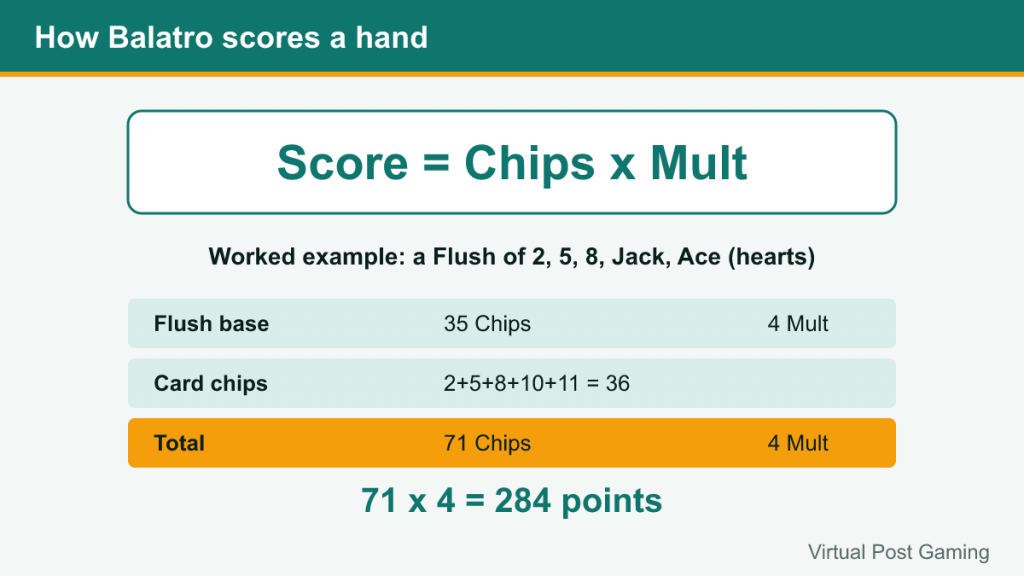
Score = Chips x Mult
Both numbers start from the poker hand you played. Each hand type has a base value for Chips and for Mult. The cards that actually count toward the hand then add their own chips: number cards are worth their rank, face cards are worth 10 and Aces are worth 11. Only cards that form the hand score by default, so a pair of kings played alongside three random cards scores the two kings only.
| Poker hand | Base Chips | Base Mult | Planet that levels it |
|---|---|---|---|
| High Card | 5 | 1 | Pluto |
| Pair | 10 | 2 | Mercury |
| Two Pair | 20 | 2 | Uranus |
| Three of a Kind | 30 | 3 | Venus |
| Straight | 30 | 4 | Saturn |
| Flush | 35 | 4 | Jupiter |
| Full House | 40 | 4 | Earth |
| Four of a Kind | 60 | 7 | Mars |
| Straight Flush | 100 | 8 | Neptune |
There are also three “secret” hands that only become possible once you modify your deck: Five of a Kind, Flush House and Flush Five.
A worked example
Say you play a flush of five hearts: 2, 5, 8, Jack and Ace. The Flush starts at 35 Chips and 4 Mult. The cards add 2 + 5 + 8 + 10 + 11 = 36 chips, for 71 Chips total. Multiply by 4 Mult and the hand scores 284.
That is a respectable early score, but it shows why the base numbers alone will not carry you far. The targets grow much faster than base hand values, so a run is really about finding ways to increase chips and, above all, mult.
Why mult matters more
Because the two values are multiplied, raising the smaller one has a bigger effect. Early in a run you usually have plenty of chips relative to mult, so +4 Mult from a Joker can be worth far more than +30 Chips. Later, the strongest builds use xMult effects, which multiply your mult rather than adding to it. A x2 effect on a hand with 20 Mult gives you 40, which is why late-game scores climb so steeply.
Blinds and Antes: The Structure of a Run
A standard run is made of eight antes. Each ante contains three rounds called blinds:
- Small Blind: the base score target for that ante.
- Big Blind: 1.5 times the base target.
- Boss Blind: usually 2 times the base target, plus a special rule that makes life harder, such as debuffing all cards of one suit or limiting how many hands you can play.
On the default difficulty, Ante 1’s base target is 300 points, so the Small Blind requires 300, the Big Blind 450 and most Boss Blinds 600. By Ante 8 the base target has risen to 50,000. Ante 8’s boss is a tougher “Showdown” blind; beating it wins the run, after which you can continue in endless mode.
You can skip the Small or Big Blind to receive a Tag, a one-time bonus such as a free Joker or a booster pack. Skipping saves you a round but also skips that round’s money and shop visit, so it is a trade-off. Boss Blinds cannot be skipped.
The boss for the current ante is shown in advance, which lets you prepare. If the boss debuffs face cards and your build relies on Kings, you know a difficult round is coming.
Hands, Discards and Hand Size
Each blind gives you a limited number of hands (plays) and discards. With the default deck you get 4 hands and 3 discards per round, with 8 cards held in hand. Each turn, you select up to five cards and either:
- Play them to score, using up one hand, or
- Discard them to draw replacements, using up one discard.
Your scores accumulate across the round. Reach the target before you run out of hands and you clear the blind; fail and the run ends. Unused hands are worth extra money at the end of the round, so clearing a blind in one big hand is rewarded.
Discards are your main tool for steering toward the hand you want. If you are building around flushes, you discard off-suit cards to dig for more of your suit. Because your deck is only 52 cards to start with, keeping track of what is left in it (the deck view shows this) helps you decide whether a discard is worth it.
Money and the Shop
After each blind you earn money: $3 for a Small Blind, $4 for a Big Blind and $5 for a Boss Blind, plus $1 for each unused hand. You also earn interest: $1 for every $5 you hold at the end of a round, capped at $5 by default. That interest rule creates one of Balatro’s central tensions. Spending money now makes you stronger immediately, while saving money pays dividends every round.
Then you visit the shop, which typically offers:
- Two cards for sale, usually Jokers but sometimes Tarot or Planet cards.
- Booster packs, from which you choose one or more cards out of a small selection.
- A voucher, a permanent upgrade for the rest of the run, such as an extra shop slot or more hands.
- A reroll button that refreshes the cards for sale, getting more expensive each time it is used in the same shop.
All of this is spent with in-run currency that you earn by playing. There is nothing to purchase outside the game itself.
Jokers: The Heart of Every Build
Jokers are what make Balatro a deckbuilder. You can hold five by default, and each one changes scoring in some way. Broadly, they fall into a few families:
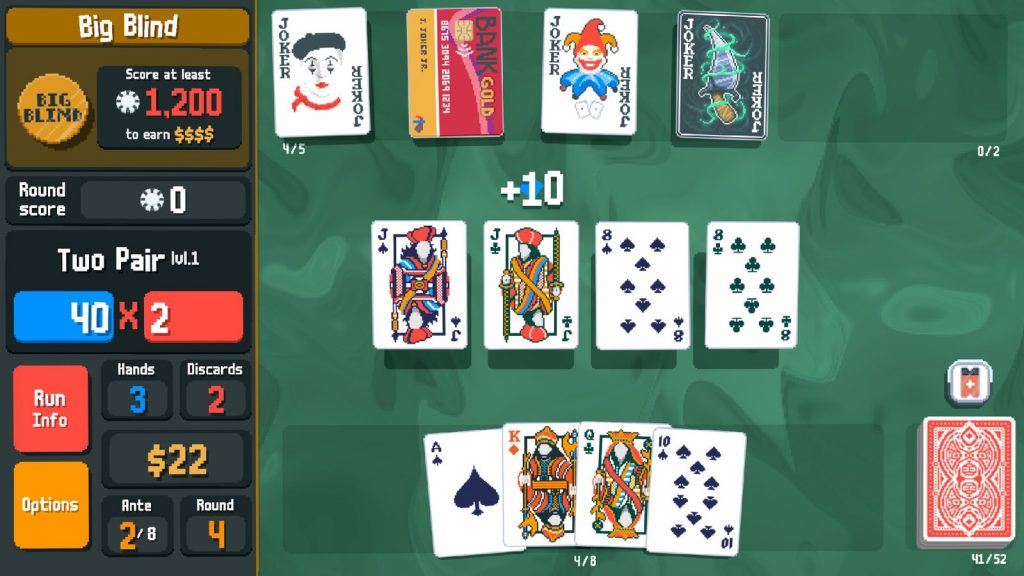
- +Chips Jokers add chips, either flat or under certain conditions.
- +Mult Jokers add to mult, for example when you play a particular hand type or a card of a particular suit.
- xMult Jokers multiply your mult and become the backbone of high scores.
- Economy Jokers generate money, which buys more Jokers later.
- Utility and retrigger Jokers change rules, such as letting certain cards score twice.
Joker order matters: they trigger from left to right, so placing additive mult Jokers before a multiplicative one gives a bigger result than the reverse. You can drag Jokers to rearrange them at any time.
Jokers can also come with editions. Foil adds chips, Holographic adds mult, Polychrome multiplies mult, and Negative adds an extra Joker slot. A strong Joker with a good edition can define a whole run.
Tarot, Planet and Spectral Cards
Balatro has three kinds of consumable cards. You hold up to two at a time by default and use them whenever you like.
Planet cards
Each Planet card levels up one poker hand for the rest of the run, increasing its base Chips and Mult. Jupiter, for example, improves Flush. Planets are how you commit to a hand type: if your build plays mostly flushes, every Jupiter makes every future flush stronger.
Tarot cards
Tarot cards modify your deck. Depending on the card, they can change a card’s suit, convert cards into another rank, destroy cards, add enhancements (such as bonus chips or mult on a specific card), or create money and other consumables. Tarot cards are how you reshape the 52-card deck itself, for example by turning more cards into hearts to make flushes easier.
Spectral cards
Spectral cards are rarer and more powerful, often with a cost attached. They can copy cards, add special seals, or give big benefits with a drawback. They are high-impact tools for later in a run.
Putting It Together: How a Good Run Develops
Most successful runs follow a similar arc, even though the details vary every time:
- Early antes: survive and build economy. Pick up a couple of Jokers that add reliable mult, and avoid spending every dollar so interest starts working for you.
- Middle antes: choose a direction. Commit to a hand type that your Jokers and Planets support, and start reshaping your deck with Tarots to make that hand easier to form.
- Late antes: add multiplication. By Ante 5 or 6, additive bonuses rarely keep pace with the targets. xMult Jokers and leveled hands are what carry you through Ante 8.
Common beginner mistakes
- Chasing big hands too early. Straight flushes look exciting but are hard to form. A leveled Pair or Two Pair played reliably often scores better in practice.
- Ignoring interest. Spending down to $0 every shop can leave you unable to afford a key Joker later.
- Keeping weak Jokers. A slot occupied by a mediocre Joker is a slot that a strong one cannot use. Selling is fine.
- Forgetting the boss. Check the upcoming Boss Blind before spending, so its rule does not shut down your build.
How Balatro Fits the Deckbuilder Family
Balatro has no monsters or health bars, yet it shares the defining trait of the genre: you reshape your deck and your rules during a run, and the run’s success depends on those decisions. Compare it to the card-reward rhythm in our Slay the Spire beginner’s guide, and you will see the same questions in a different form: what to add, what to remove, and when to commit. For the wider genre picture, see what a deckbuilder is.
Once the formula clicks, the game becomes a satisfying exercise in compounding: small improvements early make enormous scores possible later, and the moment a build finally multiplies past a huge target is what keeps players coming back for another run.