Marvel Snap Explained: Locations, Energy, Cubes and Six-Turn Games
How Marvel Snap works: 12-card decks, three random locations, six turns, energy, power, and the snap and retreat cube system that drives ranked play.
Marvel Snap was built around a simple question: what if a collectible card game took about three minutes? The answer, released on October 18, 2022, by developer Second Dinner, turned out to be one of the most distinctive card games of its decade. The studio was founded by former Hearthstone developers, including Ben Brode and Hamilton Chu, and their design strips the genre down to its decision points. Decks are tiny, games last six turns, and both players act at the same time. This guide explains how a match works and why the game plays so differently from its peers.
Marvel Snap launched on Android and iOS, with a Windows version in early access the same day that fully released in August 2023. Its first publisher was Nuverse. In January 2025, after the game briefly went offline in the United States because Nuverse is owned by ByteDance, Second Dinner announced that Skystone Games would become its publisher, with the studio bringing most publishing work in-house. As of 2026 the game continues to receive monthly seasons, balance updates and patches on mobile and PC.
The Basics: 12 Cards, 3 Locations, 6 Turns
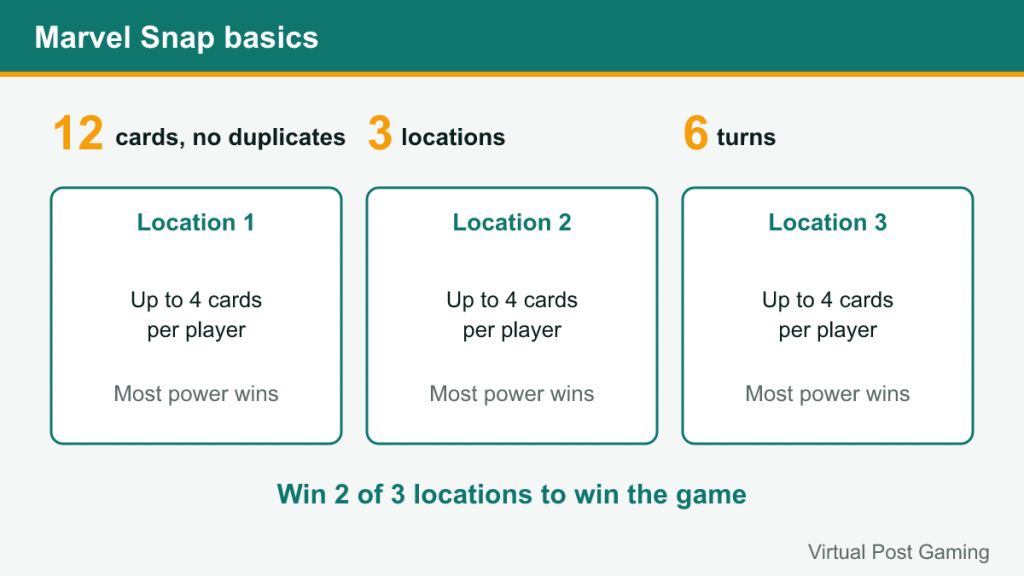
A Marvel Snap deck contains exactly 12 cards, with no duplicates. Each card has three numbers that matter:
- Cost, in energy, shown at the top left.
- Power, shown at the top right.
- An ability, if it has one, written on the card.
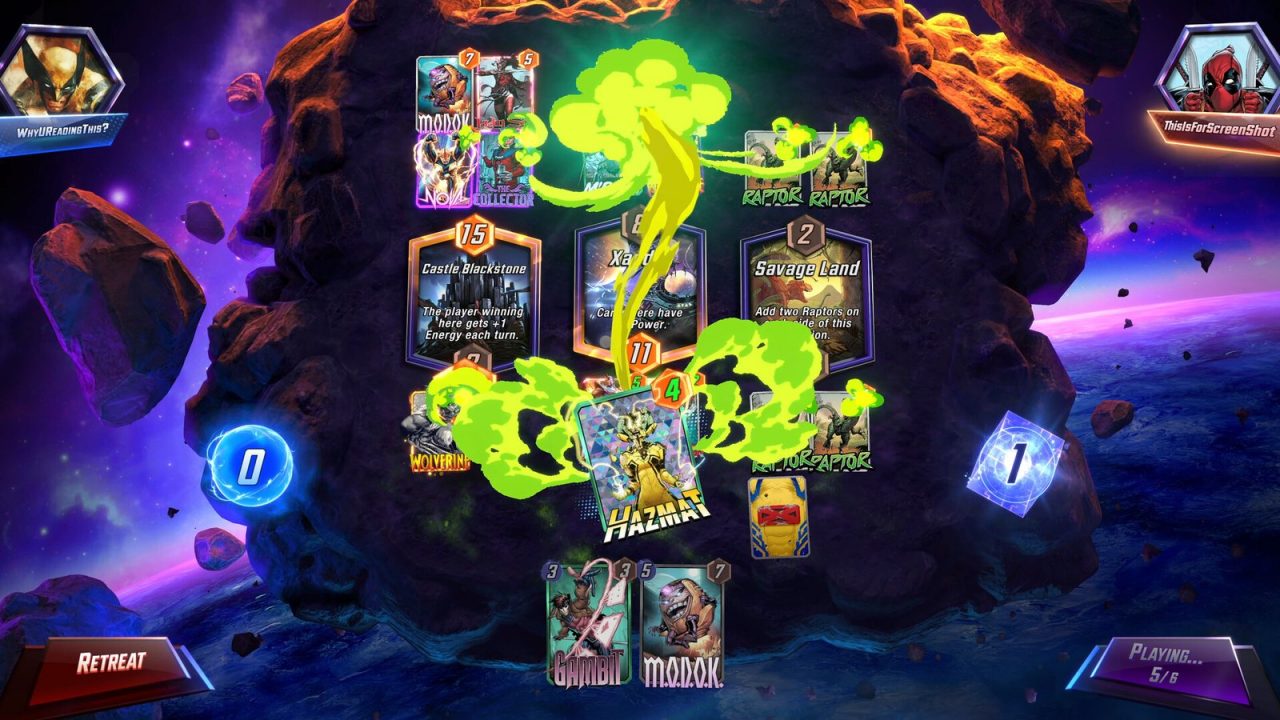
The battlefield has three locations, each holding up to four cards per player. At the end of the game, whoever has more total power at a location wins that location. Win two of the three locations and you win the game. If the locations split evenly because of a tie, the player with more total power across all locations wins.
A game lasts six turns (some locations and cards change this). You start with three cards in hand and draw one at the beginning of each turn, so by the final turn you will have seen most of your 12-card deck. Your hand can hold up to seven cards.
Energy
Energy is Marvel Snap’s mana. On turn one you have 1 energy, on turn two you have 2, and so on up to 6 energy on the final turn. Unspent energy does not carry over. Because there are only six turns, the energy curve is predictable for both players, which is a big part of what makes the game readable: you know exactly how much your opponent can spend on each turn.
Simultaneous Turns and Reveal Order
The feature that most surprises newcomers is that both players take their turns at the same time. You place your cards face down, your opponent does the same, and when both have ended their turns, the cards are revealed.
Reveal order follows a rule called priority. The player who is currently winning more locations reveals their cards first. If locations are tied, the player with more total power reveals first, and if that is tied too, the order is random. The game shows who has priority by a glow around the player’s name. Within each player’s reveal, cards flip in the order they were played.
Reveal order matters a lot because many card abilities depend on what is already on the board. An “On Reveal” ability that targets an enemy card can only see cards that have already been revealed. Learning to anticipate priority is one of the first skills that separates new and experienced players.
Key ability types
- On Reveal: triggers once, when the card flips face up.
- Ongoing: applies continuously while the card is on the board, for example adding power to other cards at its location.
- Activate: a newer ability type that you trigger yourself on a later turn.
- Destroy, Discard and Move: card families that remove cards from play, use the hand as a resource, or shift cards between locations.
Locations: The Random Element
Each match draws three locations at random from a large pool. They begin hidden and are revealed one per turn: the left location on turn one, the middle on turn two and the right on turn three. Every location has its own rule. Some are harmless, while others completely change how the game plays: adding power to cards played there, destroying cards, giving extra energy, limiting which cards can be played, or adding a seventh turn.
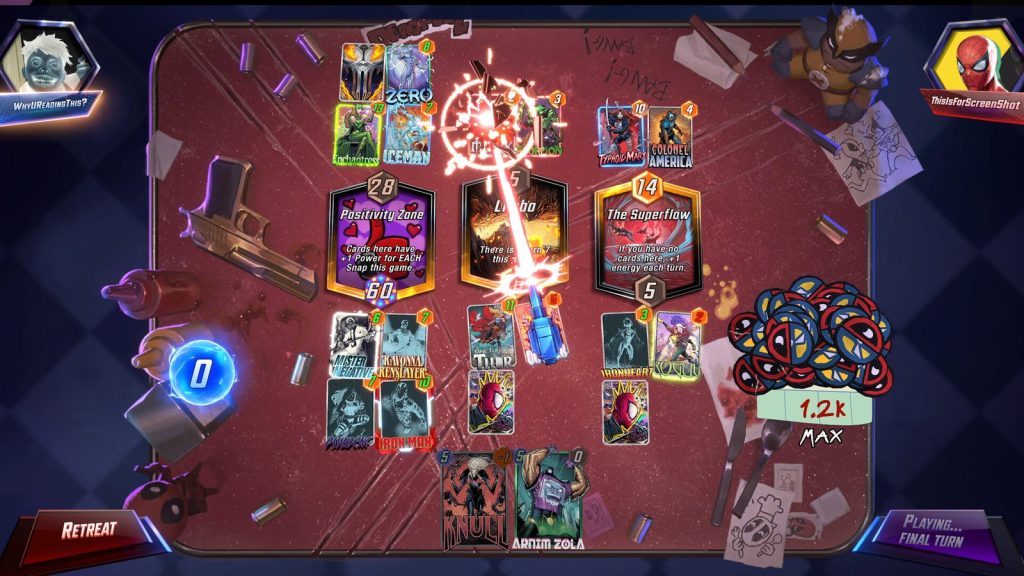
Locations are why no two games look the same. A deck that is excellent in one match might find a key location shut down in the next. Good play means adapting: noticing on turn three that the right-hand location makes a planned play impossible and adjusting your turns four to six accordingly.
Cubes, Snapping and Retreating
Ranked Marvel Snap does not just track wins and losses. It uses cubes, an in-game ranking currency that moves your position on the ladder. Cubes have no real-money value; they exist only to measure rank.
Here is how the stakes work:
- Every game starts with 1 cube at stake.
- At any time, either player can press the Snap button to double the stakes. The doubling takes effect at the start of the next turn.
- Both players can snap, once each, so stakes can double twice.
- At the start of the final turn, the stakes automatically double once more.
- The maximum, if both players snap, is 8 cubes.
At any point, either player can retreat. Retreating ends the game immediately and the retreating player loses the cubes currently at stake, rather than the higher amount they might have lost by playing on. If an opponent snaps and you do not like your position, retreating limits the damage.
Why this system matters
The snap mechanic turns every game into a test of judgement. Winning lots of games is not enough; what matters is winning big when you are ahead and losing small when you are behind. A player who retreats from bad positions early and snaps when confident can climb steadily even with an ordinary win rate. The fact that both players see the snap means it is also a source of information: an opponent snapping on turn two is telling you something about their hand.
Cubes simply move you up and down the rank ladder, which runs in monthly seasons. They are a scoring tool for ranked play, nothing more.
Collecting Cards: Collection Level and Series
Marvel Snap’s collection works differently from most card games. There are no booster packs to open in the usual sense. Instead, the main free progression is Collection Level.
You raise Collection Level by upgrading the cosmetic appearance of cards you own, using resources earned by playing. Upgrading does not change a card’s power or ability, only its look (borders, 3D effects, animations). Every upgrade raises your Collection Level, and the Collection Level track awards rewards, including new cards.
Cards are grouped into series (earlier called pools). The early series are unlocked first through the Collection Level track, and later series contain cards that are harder to obtain. Newer and rarer cards tend to sit in the higher series and move down to more common series over time. Exact unlock thresholds and reward rules have changed several times since launch, so the in-game collection screen is the place to check how the system currently works.
The important beginner point: you do not need every card. Because decks are only 12 cards, a few well-understood decks built from early-series cards are enough to learn the game and climb meaningfully. Like other free-to-play card games, Snap sells optional cosmetics and bundles; none of it is needed to enjoy or learn the game.
Why Marvel Snap Plays So Fast
Several design decisions combine to keep games short:
- Fixed length. Six turns means you always know when the game ends; there is no grinding long game.
- Simultaneous turns. Neither player waits for the other to finish, cutting the length of a match roughly in half compared with alternating turns.
- No life totals. Instead of chipping away at health over many turns, everything is decided by the board on the final reveal.
- Tiny decks. Twelve cards means less deck variance and faster decisions.
- Retreating. Lopsided games often end early, because the losing player simply leaves.
Compare this with Hearthstone, where turns alternate and games can stretch over many minutes; our Hearthstone beginner’s guide shows how differently a traditional digital card game paces itself.
Other Modes
Beyond ranked, Marvel Snap has added several ways to play over the years. Conquest is a mode of multi-game matches using health instead of cubes, organised into leagues. Battle Mode, added in January 2023, lets you challenge a friend directly, again with health rather than cubes. Limited-time modes such as Deadpool’s Diner and High Voltage have appeared for set periods. Availability of special modes changes, so check the game menu for what is running.
Beginner Tips
- Read every location as it appears. Plan the next turn around what the newly revealed location does.
- You only need two locations. Spreading power across all three is often worse than winning two decisively.
- Use all your energy. Wasted energy on early turns is a common way to fall behind, so include some cheap cards.
- Snap when you are confident, retreat when you are not. Retreating is not quitting; it is part of good play.
- Count the last-turn options. Your opponent will have 6 energy on turn six. Ask what they could play and where.
- Stick with one deck while learning. Understanding why a deck wins teaches you more than constantly switching.
Marvel Snap is easy to start and deceptively deep. Its six-turn games leave little room for error, and the cube system rewards reading your position honestly. Once the rhythm of hidden plays, priority and the final reveal clicks, it becomes clear why such a short game has kept players coming back for years.