Portal and Portal 2 Explained: How the Portal Gun Puzzles Work
How Portal's puzzles work: linked portals, momentum and flinging, portal surfaces, cubes, buttons, lasers, light bridges, funnels and gels, and how Valve teaches it all.

Portal has one of the simplest premises in puzzle gaming: you have a device that creates two linked holes in the world, and whatever goes in one comes out of the other. From that single idea, Valve built two of the most admired puzzle games ever made. This guide explains the mechanics that drive the puzzles, the elements each game adds, and the careful way both games teach you to think with portals, without spoiling story moments.
Where Portal Came From
The portal mechanic began as a student project. Narbacular Drop, released in 2005, was a free game made by a team of students at the DigiPen Institute of Technology, in which the player placed two connected portals to solve puzzles. Valve saw it, hired the team, and set them to work on a new game built on the same idea. Kim Swift, part of that student team, became Portal’s designer, with writing by Erik Wolpaw and Chet Faliszek.
Portal was released in October 2007 as part of The Orange Box for Windows and Xbox 360, with a PlayStation 3 version following that December. It was short, compact and widely seen as a surprise highlight of the package, and it won Game of the Year at the 2008 Game Developers Choice Awards. Valve followed it with the much larger Portal 2 in April 2011 for Windows, macOS, PlayStation 3 and Xbox 360. Both games came to Nintendo Switch in 2022 as the Portal: Companion Collection.
In both games you play as Chell, a test subject moving through the “test chambers” of the Aperture Science facility, overseen by an artificial intelligence called GLaDOS. Each chamber is a self-contained puzzle with an exit to reach.
The Portal Gun: The Core Rules
The portal device fires two kinds of portal, traditionally coloured blue and orange. Only one of each can exist at a time; firing a new blue portal removes the old blue one. When both are placed, they are linked: step into one and you step out of the other, facing outward from its surface.
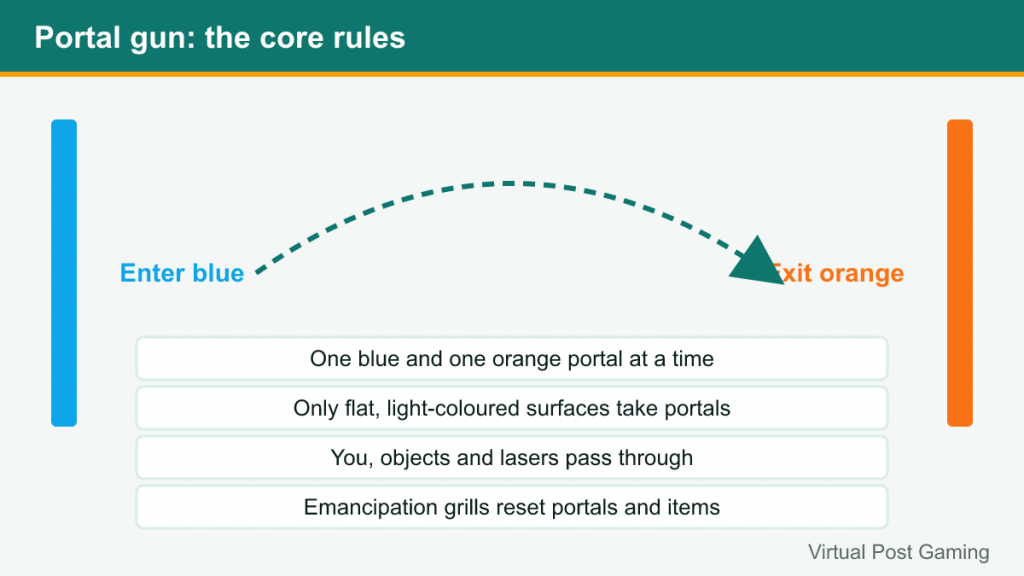
A few rules define almost every puzzle:
- Portals need the right surface. They can be placed on flat, light-coloured panels, but not on dark metal, glass, moving surfaces or most special materials. Much of each puzzle is figuring out which surfaces are available.
- You can see and shoot through portals. Lines of sight, and lasers, carry through, which lets you reach places you cannot walk to directly.
- Objects travel too. Cubes, turrets and other items pass through portals just as you do.
- Emancipation grids reset things. Shimmering fields called Material Emancipation Grills remove your portals when you pass through them and destroy objects carried through them. They stop you from carrying solutions from one room into the next.
Momentum: “Speedy Thing Goes In, Speedy Thing Comes Out”
The most important idea in Portal is that momentum is preserved through portals. If you fall at high speed into a portal on the floor, you shoot out of the linked portal at the same speed, in whatever direction that portal faces. Portal 2 sums the principle up in a line from GLaDOS: “speedy thing goes in, speedy thing comes out.”
This creates the signature move players call flinging:
- Place one portal on the floor at the bottom of a long drop.
- Place the other portal on a wall, angled toward the gap you need to cross.
- Jump down the drop. You fall, enter the floor portal, and fly out of the wall portal with all the speed you gained.
Several things follow from this. The height of the drop determines how far you fly. The direction you exit depends on the orientation of the exit portal, not on the direction you were moving before. And you can sometimes create an infinite fall, placing portals on the floor and directly above on the ceiling, to build up speed before redirecting yourself. Learning to read a room for “where can I gain speed, and where do I need to go?” is a big part of mastering the game.
Like the wall kicks we describe in how modern Tetris works, flinging can look like magic to an onlooker, but it follows consistent rules that you can learn and predict.
Test Chamber Elements in Portal
The first game keeps its toolkit small. The main elements are:
- Weighted Storage Cubes. Heavy boxes you can carry and drop. They hold down buttons, act as steps, and can be flung through portals.
- Floor buttons. Large switches that need weight on them to stay active, usually a cube or the player, often opening a door elsewhere.
- Energy pellets. Glowing balls that bounce around a room and must be guided into a receptacle, often by placing portals in their path.
- Moving platforms. Platforms that travel along tracks, sometimes activated by pellets or buttons.
- Hazards. Toxic liquid on floors, and sentry turrets that fire on you if they can see you. Turrets can be knocked over or dropped through portals, which makes them part of the puzzle rather than enemies to fight.
The original also introduced one particular cube with hearts printed on its sides, the Weighted Companion Cube, which became one of the game’s most famous objects.
What Portal 2 Adds
Portal 2 keeps the same portal rules but adds a much wider set of tools that interact with them:
Hard Light Bridges
Flat bridges of solid light that project from an emitter until they hit a surface. Put a portal in a bridge’s path and it continues out of the other portal, so you can redirect a bridge to create a walkway, or project it against a wall as a shield.
Lasers and redirection
Thermal Discouragement Beams are lasers that must be guided into receivers to power doors or mechanisms. Portals redirect them, and Discouragement Redirection Cubes, cubes with lenses, can bend a laser in a new direction. Lasers also hurt the player and can destroy turrets.
Excursion Funnels
Tractor beams that carry you and objects slowly along their length. Some can be reversed to push or pull. Through portals, a funnel can carry you across a room or lift you upward.
Aerial Faith Plates
Catapult panels that launch you along a set arc. Combined with portals, they let you change where that arc ends up.
Gels
Paint-like liquids, based on ideas from another DigiPen student game, Tag: The Power of Paint, whose team Valve also hired:
- Repulsion Gel (blue) makes surfaces bouncy.
- Propulsion Gel (orange) makes you run much faster over it.
- Conversion Gel (white) makes almost any surface accept portals.
Gels flow through portals, so you can paint surfaces that are otherwise out of reach. Conversion Gel in particular changes the core rule about where portals can go, opening up puzzles that would be impossible otherwise.
Co-op
Portal 2 also features a separate two-player cooperative campaign with two robots, Atlas and P-Body. Each has their own pair of portals, so four portals exist at once, and the puzzles are built around coordination: one player holds a bridge in place while the other uses it, or both fling in sequence.
How the Games Teach Without Telling
The most admired aspect of Portal’s design is how it teaches. The games rarely explain anything directly. Instead, each new idea is introduced in a careful sequence:
- Introduce in isolation. A new element appears in a small, safe room where the only thing to do is interact with it.
- Confirm understanding. The next room requires using it in a simple, slightly different way.
- Combine. Later chambers mix the new element with things you already know.
- Twist. Finally, a puzzle asks you to use an element in a way you did not expect, such as using a light bridge as a wall rather than a floor.
The first game even gives you the portal gun in stages: early chambers have portals placed for you, then you control only one colour, and only later the full device. That way, by the time puzzles demand full control, you have absorbed the rules without a single tutorial screen.
Valve has described its development as heavily shaped by playtesting. Much of Portal’s story itself was added because testers wanted to know why they were doing the tests, and early Portal 2 ideas were reworked after playtest feedback.
Thinking With Portals: Tips for Getting Unstuck
- Find the portal surfaces first. Look around the whole room and note every surface that accepts portals. The solution almost always uses some of them.
- Identify the exit and work backwards. Ask what has to happen just before you reach the exit: a door open, a bridge in place, a fling from a certain height.
- Ask where speed could come from. If the exit is far away across a gap, look for a high ledge or pit you could use to build momentum.
- Remember objects can travel. If a button is out of reach, maybe a cube can get there through a portal.
- Use both portals as tools. Often one portal stays fixed as an anchor while you move the other around.
- Look up. Ceilings and high walls are easy to overlook.
Puzzles are designed to have a clear intended solution, and the “aha” moment usually arrives when you notice a surface or an interaction you had dismissed.
Community Puzzles and Lasting Influence
Portal 2 received a level editor, and Steam Workshop support let players share custom test chambers, giving the game a long tail of community puzzles. Fan-made projects such as Portal Reloaded expanded the formula further. The games also inspired a wave of first-person puzzle games built around a single, rigorously explored mechanic.
What makes Portal endure is the clarity of its rules. You never need to guess what a portal will do. Every puzzle is solved with the same tools, and the challenge lies entirely in seeing how they combine. It is a near-perfect example of a puzzle game built on one idea and explored to its limits.