How Modern Tetris Works: Hold, 7-Bag, SRS and T-Spins Explained
The rules behind modern Tetris: the 7-bag randomizer, hold and next queue, SRS rotation and wall kicks, lock delay, T-spins, combos, back-to-back and garbage.
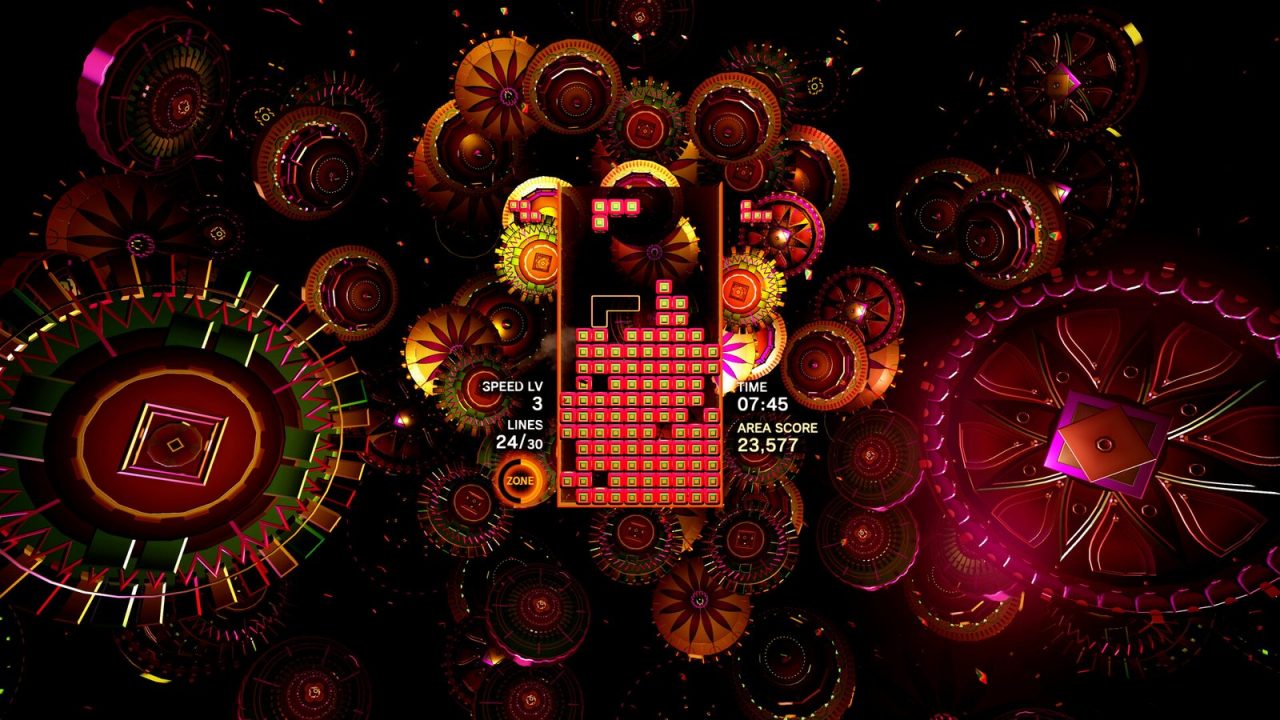
If you last played Tetris on an old Game Boy or NES and then pick up a modern version, it can feel like a different game. Pieces can be held in reserve, you can see several pieces ahead, they rotate into gaps that look impossible, and the scoreboard rewards strange-looking twists called T-spins. None of this is accidental. Since 2001, official Tetris games have followed a shared rulebook known as the Tetris Guideline, maintained by The Tetris Company. This guide explains its key mechanics and why they changed how the game is played.
The Playfield and the Seven Tetrominoes
The basics have not changed. The playfield (the “matrix”) is 10 cells wide and 20 visible rows tall. Under the Guideline there is also a hidden buffer area above the visible rows, where pieces spawn and where blocks can briefly sit. Pieces fall from the top, and any horizontal row completely filled with blocks clears, causing everything above to drop down.
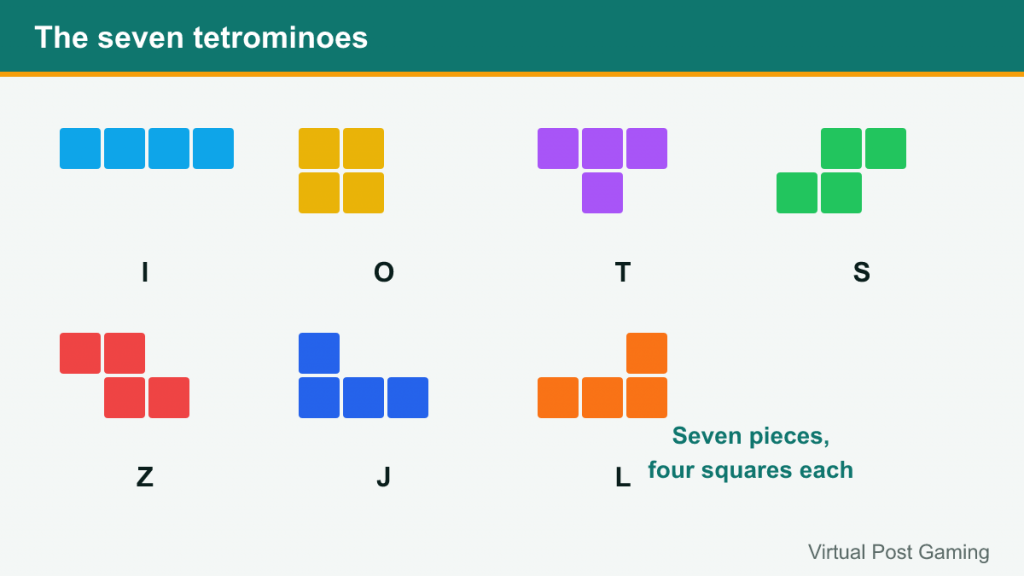
There are seven pieces, called tetrominoes (official materials often spell it “tetriminos”), each made of four squares. The Guideline also fixes their colors, so they look the same across official games:
| Piece | Shape | Guideline color |
|---|---|---|
| I | Four in a straight line | Light blue (cyan) |
| O | 2×2 square | Yellow |
| T | Three in a row with one on top | Purple (magenta) |
| S | Zig-zag, rising to the right | Green |
| Z | Zig-zag, rising to the left | Red |
| J | Three in a row with one at the left end | Dark blue |
| L | Three in a row with one at the right end | Orange |
Pieces spawn centered at the top of the matrix, flat side down, and begin falling immediately. Clearing four lines at once with an I piece is called a Tetris, the move the game is named after.
The game ends when you top out: a new piece cannot spawn because blocks are in the way, a piece locks entirely above the visible area, or garbage pushes blocks off the top of the buffer.
The 7-Bag Randomizer
In early versions, the next piece was chosen more or less at random, so you could wait a very long time for an I piece, or get several S and Z pieces in a row. Modern Tetris uses the random bag system, usually called the 7-bag.
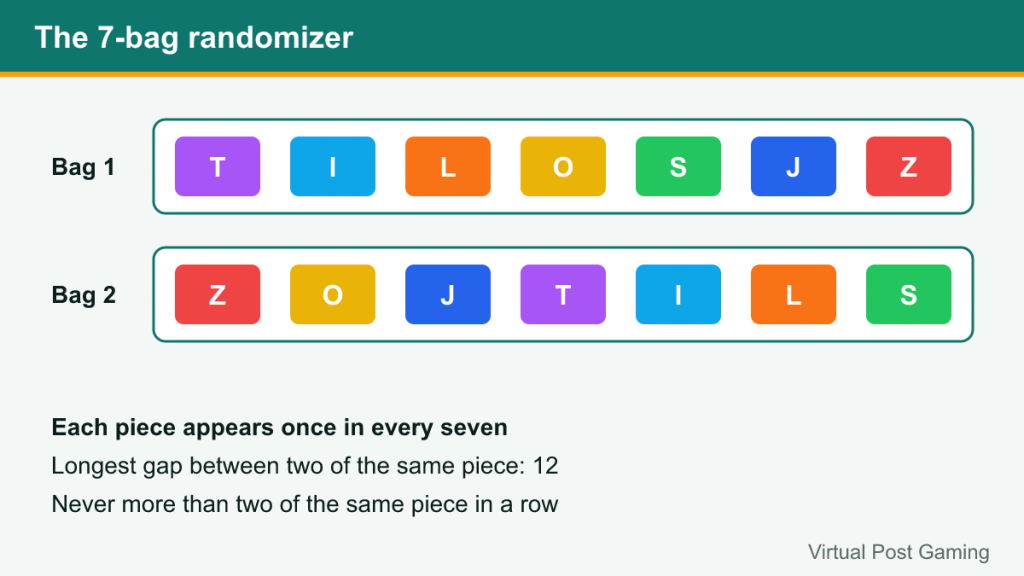
It works like drawing from a bag of seven tiles. All seven pieces go into a virtual bag and are shuffled. The game deals them out one by one until the bag is empty, then refills and reshuffles. If you play card games, think of it as a seven-card deck that is drawn to the bottom and then shuffled again, much like the draw-and-reshuffle loop described in our guide to deckbuilders. The consequences are significant:
- You will always get each piece once in every seven.
- The longest possible gap between two of the same piece is 12 pieces (if one appears first in a bag and last in the next).
- You can never get more than two of the same piece in a row (last of one bag, first of the next).
- A run made only of S and Z pieces can be at most four pieces long, so the old floods of awkward zig-zags are gone.
The bag makes Tetris far more predictable and therefore more skill-based. Top players count pieces within the current bag to know what must be coming soon.
Hold and the Next Queue
Hold
The hold box lets you set the current piece aside and swap it with the held piece (or, if the box is empty, take the next piece from the queue). You can only hold once per piece: after using hold, you must place the active piece before you can hold again. That rule prevents endless stalling.
Hold is one of the most powerful tools in modern Tetris. You can save an I piece for a Tetris, park an awkward S or Z until there is a good place for it, or keep a T piece ready for a T-spin.
Next queue
Modern games show several upcoming pieces, commonly up to six, instead of the single preview of older versions. With a long queue and the 7-bag, you can plan several placements ahead and almost never be truly surprised.
SRS: Rotation and Wall Kicks
The Guideline uses the Super Rotation System (SRS) to determine how pieces turn. Each piece has four orientations, and you can rotate both clockwise and counterclockwise.
The clever part is wall kicks. When you rotate a piece and its new orientation would overlap a wall, the floor or other blocks, the game does not simply refuse. Instead it tests up to five positions in sequence: the basic rotation, then a series of shifted positions, and uses the first one that fits. Only if all five fail does the rotation fail. The I piece has its own set of test positions because of its length, and the O piece does not kick at all.
Kicks have several effects on play:
- Pieces can rotate even when pressed against a wall.
- Pieces can be rotated into spaces that look blocked, including tucking underneath an overhang.
- Rotations are reversible: rotating clockwise and then counterclockwise returns a piece to where it started.
That second point is what makes T-spins and other “spin” moves possible. To a beginner, kicks can feel like the piece is teleporting, but they follow fixed rules that skilled players learn.
Drops, Lock Delay and Handling
Soft drop and hard drop
A soft drop makes the piece fall faster while you keep control. A hard drop sends it straight to the bottom and locks it instantly. Modern games also show a ghost piece, a faint outline of where the piece will land. Hard drop combined with the ghost is the foundation of fast play: you position the piece and slam it down without waiting.
Lock delay
When a piece lands on a surface, it does not lock immediately. The Guideline gives a lock delay of half a second, during which you can still move or rotate it. Under the common “move reset” rule, moving or rotating resets the timer, but only up to 15 times; after that the piece locks the moment it touches down. This allows last-moment adjustments, including slide-ins and spins, while preventing infinite stalling.
DAS and ARR
When you hold left or right, the piece moves once, pauses, then auto-repeats. The pause is called DAS (delayed auto shift) and the repeat speed ARR (auto repeat rate). Many modern Tetris games let you tune these. Faster settings let a piece reach the wall almost instantly, which helps a lot at higher speeds.
T-Spins Explained
A T-spin is a line clear made by rotating a T piece into a slot that it could not simply drop into. The game recognises it using the three-corner rule: after the T piece’s final move is a rotation, the game checks the four diagonal corners around the T’s center. If at least three of them are occupied by blocks or walls, it counts as a T-spin. Smaller versions that meet only part of the test are called T-spin Minis.
T-spins matter because the Guideline rewards them heavily. Under the standard scoring table, at level 1:
| Clear | Points (x level) |
|---|---|
| Single | 100 |
| Double | 300 |
| Triple | 500 |
| Tetris | 800 |
| T-spin Single | 800 |
| T-spin Double | 1,200 |
| T-spin Triple | 1,600 |
A T-spin Double, which clears only two lines, is worth more than a Tetris. The most common practice setup is the T-spin Double slot: a three-wide hole with an overhang on one side, into which the T is rotated to fill two rows at once. Many players learn named setups to build these reliably from the 7-bag.
Combos, Back-to-Back and Perfect Clears
Combos
A combo is a sequence of consecutive pieces that each clear at least one line. Each extra clear in the chain adds a bonus (50 x combo count x level in the standard table), and in multiplayer games combos send extra garbage.
Back-to-back
Tetrises and T-spin line clears are classed as “difficult” clears. If you make two of them in a row, with no ordinary Single, Double or Triple in between, the second earns a back-to-back bonus: 1.5 times its normal score. A T-spin that clears no lines does not break the chain. That rewards players who build only toward difficult clears instead of cashing in easy lines.
Perfect clears
Clearing every block from the matrix is an All Clear or Perfect Clear, and later Guideline games award a large bonus for it. Players have studied perfect-clear openers that work from the very first bag.
Garbage: How Versus Tetris Works
In head-to-head and battle royale Tetris games, line clears send garbage to opponents: gray rows with a single gap that rise from the bottom of their matrix. The amount depends on the clear, and exact tables vary between games. Generally, a Single sends little or nothing, while Tetrises, T-spins, back-to-back bonuses and long combos send much more. Players can cancel incoming garbage by clearing lines before it arrives.
This turns T-spins and back-to-back chains from score bonuses into attacks, which is why competitive players build their whole strategy around them.
Modern Guideline Tetris vs Classic NES Tetris
Classic NES Tetris (1989) is still played competitively, but it runs on very different rules:
- No hold, and only one next piece is shown.
- No hard drop and no ghost piece.
- No wall kicks: if a rotation is blocked, it simply fails.
- A simpler randomizer without the 7-bag, so droughts of I pieces happen.
- No T-spin rewards; Tetrises are the only big scoring move, worth far more than smaller clears.
- Much faster gravity at high levels, which led to special movement techniques.
Neither is the “real” Tetris. Classic Tetris tests stacking and speed under strict limits; modern Tetris adds tools that open a different, more technical style built on spins, combos and planning. If you are moving from one to the other, expect to relearn some habits.
How to Practise These Mechanics
- Learn hard drop with the ghost. Stop waiting for pieces to fall.
- Use hold deliberately. Keep an I or T piece in hold when you have a place ready for it.
- Read the next queue. Plan two or three pieces ahead.
- Practise the T-spin Double slot. Build it slowly in a practice mode until it feels natural.
- Keep the stack flat. A low, even surface gives every piece a good place to go.
Once these feel automatic, the 7-bag and SRS stop feeling like rules and start feeling like tools, and that is when modern Tetris really opens up.