The Witness Without Spoilers: How to Approach Jonathan Blow’s Island of Puzzles
A spoiler-free guide to The Witness: how its line puzzles work, how the island teaches without words, and how to get unstuck without looking up answers.
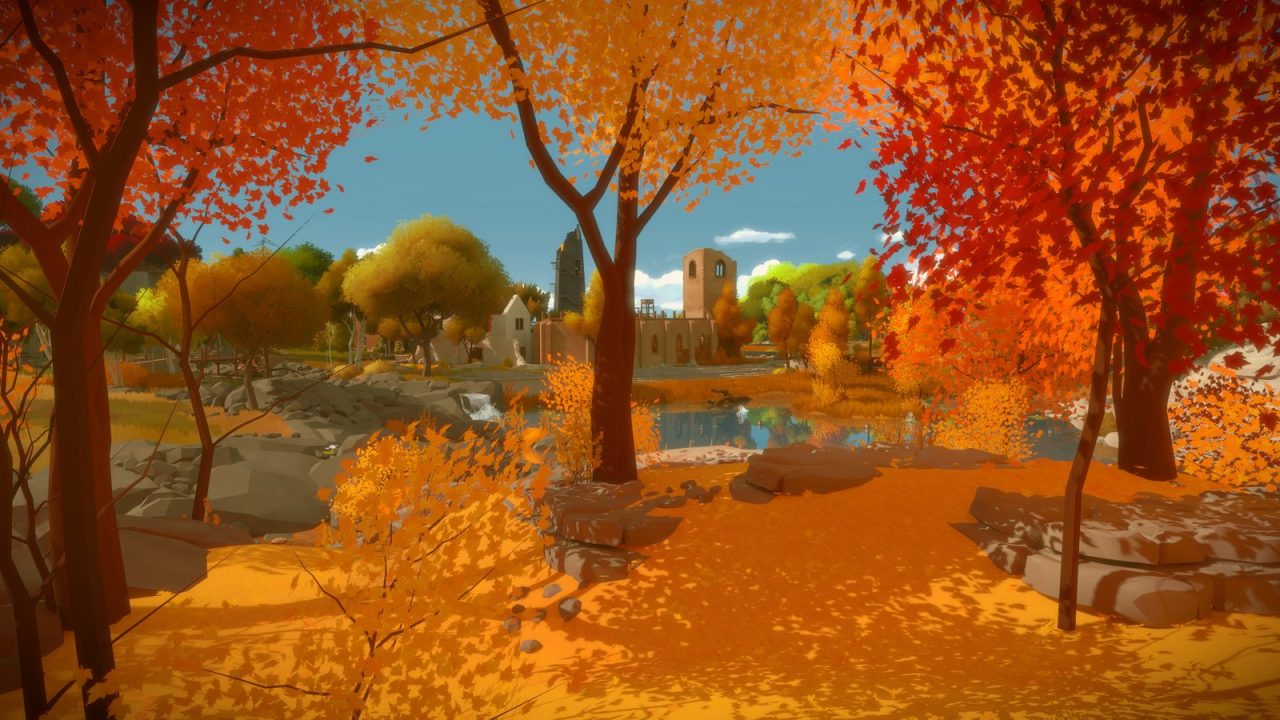
The Witness is a game best played knowing as little as possible. It drops you on an island with no instructions, no tutorial text and no stated goal, and lets you discover everything for yourself. That sense of discovery is the whole point, which makes writing a guide to it a delicate job. This article explains how to approach the game: what kind of puzzles it contains, how it teaches its rules, and what to do when you are stuck. It does not reveal solutions, the meaning of any symbol beyond the very first ones you meet, the game’s secrets or its ending.
What The Witness Is
The Witness was developed and published by Thekla, Inc., the studio founded by Jonathan Blow, the designer of the 2008 puzzle-platformer Braid. It was released on January 26, 2016, for PlayStation 4 and Windows, followed by Xbox One in September 2016, macOS in March 2017 and iOS in September 2017. It also appeared on Nvidia Shield in early 2017.
The game is a first-person exploration puzzle game set on a colourful, apparently deserted island. Its puzzles are almost all line puzzles on panels: you trace a path from a start point to an end point across a grid, and the path must obey rules indicated by symbols on the panel. The official store page advertises more than 500 puzzles (some counts that include hidden ones run higher), and the developer estimated that an average player would need around 80 hours to solve them all, though you do not have to solve every puzzle to finish the game.
There is no combat, no timer for most puzzles and no way to die. Your only tools are your eyes, your memory and your reasoning.
The Puzzle Language: How Panels Work
Every panel shares a basic grammar, which the game establishes in the first few minutes:
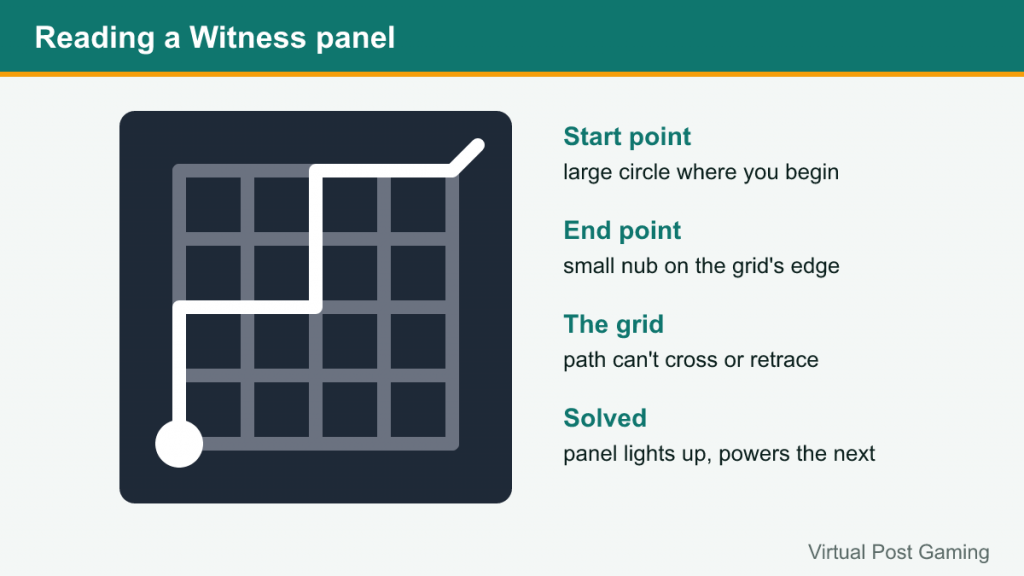
- A start point, shown as a large circle, where you begin drawing.
- An end point, a small rounded nub sticking out from the grid’s edge, where the line must finish.
- The grid, along whose lines your path travels. It cannot cross itself or retrace its steps.
When you finish a valid path, the panel lights up and usually powers something, often a cable leading to the next panel or a door. When the path is wrong, the panel shows you which rule was broken by making the offending symbol flash.
Beyond that, each area of the island introduces symbols on the panels that add constraints to where your line may go. The game never tells you what a symbol means. Instead, it gives you a sequence of panels that starts trivially simple, so you can work out the rule by experiment, and then builds in difficulty until you understand it deeply. Explaining those rules would take away exactly what the game is built to give you, so we will leave them for you to discover.
Why the language works
The panels are effectively a single, expandable notation. Once you have learned what a symbol means, it means the same thing everywhere on the island. Later panels mix symbols from different areas, so your knowledge builds on itself. This makes the game feel less like a collection of puzzles and more like learning a language whose vocabulary keeps growing.
How the Island Teaches Without Words
The Witness is famous for teaching entirely through design. A few techniques recur constantly:
Sequences of panels
Most areas present panels in a row, connected by cables. The first panel in a sequence is often almost impossible to get wrong: there is one obvious path. Its purpose is to show you a symbol and confirm a hypothesis. The next panel tests that hypothesis in a slightly different arrangement. By the end of a sequence, you are solving puzzles that would have been baffling at the start.
Mistakes as information
Because a failed panel highlights the symbol you violated, every wrong answer teaches you something. Trying something and failing is not a waste; it is how the game communicates. Many players find it useful to make a deliberately “wrong” attempt just to see which symbol complains.
Order and gating
Some areas cannot be fully solved until you understand rules taught elsewhere. If a panel seems impossible, you may simply not know the relevant rule yet. The game does not tell you this, which can be frustrating, but it is also part of the design: the island is open, and you are expected to wander away and come back.
Looking Beyond the Panels
Not every clue is printed on a panel. Some areas ask you to pay attention to your surroundings: to what you can see from where you are standing, to the way objects line up, or to other information present in the environment. The game hides some of its most surprising puzzles in plain sight, using the scenery itself.
Without giving anything away, the best advice is simply this: if an area seems to contain more than panels, it probably does. Look around, move your viewpoint, and ask why something looks the way it does. The island was designed with extraordinary care, and very little in it is accidental.
You will also find audio logs scattered around, containing recorded quotations from a range of thinkers and writers. They are optional and not needed to solve puzzles, but they give context to the game’s themes about perception and understanding.
The Structure: Regions and Progress
The island is divided into distinct regions, each with its own visual identity and its own puzzle theme. Solving a region’s key puzzles activates a device that shines a beam of light (players usually call these lasers) toward a central point on the island. You can tackle most regions in whatever order you like.
Because of that openness, there is no single correct route. If one region becomes too difficult, the right move is often to leave it and explore another. Knowledge you gain elsewhere may be exactly what unlocks the puzzle you abandoned.
Not every puzzle on the island is required to reach the game’s ending. Some players finish the main path and stop; others continue for many more hours chasing optional challenges and hidden content. Both are legitimate ways to play.
Getting Unstuck Without Looking Up Solutions
The Witness is a game where looking up an answer can undo much of the experience, because the joy comes from the moment of understanding. Here are ways to get unstuck while preserving that moment.
1. Go back to the beginning of the sequence
If you are stuck on the fifth panel in a row, revisit the first ones. Ask what each panel was trying to teach. Often an earlier panel contains a hint you solved without fully understanding.
2. State the rule out loud
Try to describe, in words, what you think a symbol requires. If you cannot state the rule clearly, you probably do not fully understand it yet. If you can state it, check whether your rule actually explains every panel you have solved so far. A rule that explains most but not all of them is the wrong rule.
3. Use deliberate wrong answers
Draw a path you suspect is wrong and see which symbol flashes. This turns guessing into an experiment.
4. Take notes or photos
Some later puzzles are complex enough that sketching them on paper helps. Copying a panel onto a grid lets you try paths without the pressure of the screen. Taking a screenshot to refer back to is also useful.
5. Leave and come back
The game is built around this. If an area is stalling you, go elsewhere. It is common to return later and find a puzzle suddenly obvious, either because you learned something new or simply because you are looking at it fresh.
6. Take a real break
Many players report solving puzzles away from the screen. Sleeping on a problem, or just stepping away for a while, gives your mind room to see it differently.
7. If you need help, ask for a hint, not an answer
If you do turn to outside help, ask a friend for a nudge rather than looking up a full solution. Questions like “which area should I explore first?” or “is there a rule I haven’t found yet that this panel needs?” can get you moving without giving the puzzle away.
Common Frustrations and How to Think About Them
- “This panel seems impossible.” It may be. Not every panel is meant to be solved the first time you see it. Move on and return later.
- “I solved it but don’t know why.” Go back and study it. Lucky solutions leave gaps that hurt later.
- “I’m lost.” There is no map, but the regions are visually distinct. Climbing to high points helps you get your bearings.
- “I’m not sure if I’m making progress.” If you have learned something new about a rule today, you are making progress, even without solving a panel.
How The Witness Compares With Other Puzzle Games
Like Portal, The Witness teaches its rules through carefully ordered challenges rather than instructions; our guide to how Portal’s puzzles work explores that approach in a very different setting. The difference is scale and freedom. Portal moves you through a fixed sequence of rooms, while The Witness lets you wander an open island, so you can take on its lessons in many orders.
It is also a slower, more contemplative game. There is no time pressure, no score, and no penalty for taking an hour over one panel. For some players that is a perfect fit; others prefer more structure. Knowing which kind of puzzle player you are helps you set your expectations before you start.
A Few Practical Settings and Tips
- Play in long, calm sessions if you can. The game rewards concentration.
- Keep a notebook nearby. You will likely want to sketch at some point.
- Do not rush to finish. The island contains far more than the critical path.
- Avoid spoilers online. Even discussions that seem harmless can reveal one of the game’s surprises.
The Witness asks for patience and attention, and in return it offers some of the most satisfying moments of understanding in any game. Treat every failure as information, every region as a lesson, and the island itself as something worth looking at closely.