Baba Is You Explained: Puzzles Where You Rewrite the Rules
How Baba Is You works: nouns, IS and properties like YOU, WIN, STOP and PUSH, the tricks the game teaches, and how to think through levels without spoilers.
Most puzzle games hand you a fixed set of rules and ask you to work within them. Baba Is You hands you the rules as physical objects on the floor and asks you to push them around. A wall stops you only because the words WALL, IS and STOP happen to be lined up somewhere on the screen. Push one of those words out of line and the wall becomes scenery you can walk straight through.
This guide explains the rule system, the tricks the game expects you to discover, and a spoiler-free way of thinking about its levels.
Where Baba Is You Came From
Baba Is You is the work of Arvi Teikari, a Finnish independent developer known by his handle Hempuli. It began as a short prototype made for the 2017 Nordic Game Jam, where the theme was “Not There”. The jam version took first place, and Teikari expanded it into a full commercial game over the following two years.
The finished version launched on March 13, 2019, for Windows, macOS and Linux via Steam and for Nintendo Switch, with Android and iOS following in June 2021. Before release, the in-progress game won Best Student Game and Excellence in Design at the 2018 Independent Games Festival awards, and after launch it collected the D.I.C.E. Award for Outstanding Achievement in Game Design and both Best Design and the Innovation Award at the Game Developers Choice Awards.
In November 2021 a free update called Baba Make Level added a level editor with online sharing, along with new official levels, so players now build and trade their own rule-bending stages.
The Rule-Block System: Nouns, IS and Properties
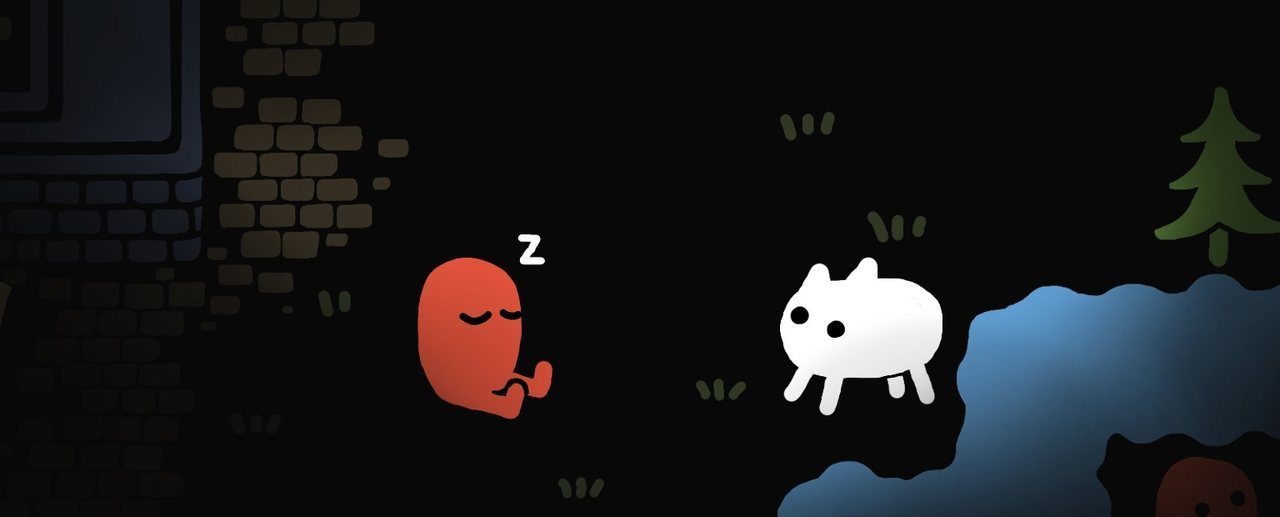
Every level is a single screen of tiles. Some tiles are objects: Baba (a small white creature), walls, rocks, flags, water, keys, doors and many more. Other tiles are words. When word tiles are lined up horizontally (left to right) or vertically (top to bottom) in a grammatically valid sentence, that sentence becomes an active rule. When the line is broken, the rule stops applying immediately.
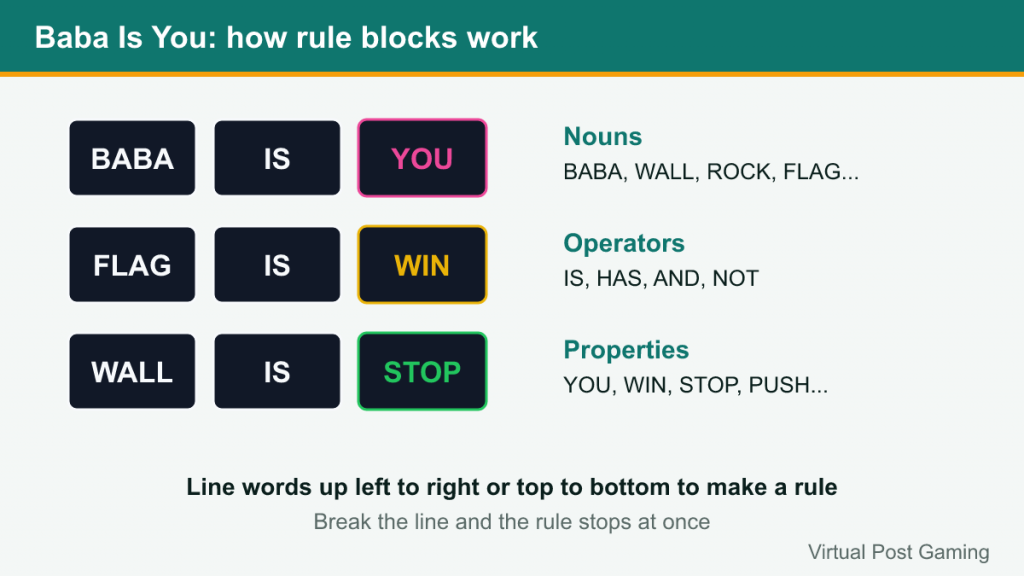
The words fall into a few categories:
- Nouns name a type of object: BABA, WALL, ROCK, FLAG, WATER, KEY and so on. A noun refers to every object of that type on the screen at once.
- Verbs and operators join the sentence together. IS is by far the most important. Later you meet others such as HAS and AND, plus NOT for negation.
- Properties describe behavior. These are the adjectives that actually change how the level works.
The core properties you meet early are:
| Property | What it does |
|---|---|
| YOU | You control every object with this property. If nothing is YOU, you cannot move (though you can still undo). |
| WIN | If an object that is YOU touches an object that is WIN, the level is complete. |
| STOP | The object blocks movement, like a solid wall. |
| PUSH | The object can be shoved one tile at a time, like a crate in a box-pushing game. |
| SINK | When something enters its tile, both it and the other object are destroyed. |
| DEFEAT | Any YOU object that touches it is destroyed. |
More properties appear as the game goes on, each introduced in a level built to teach it. The key point is that properties are not attached to objects permanently. They exist only because a sentence on the screen says so.
Two kinds of sentence
Rules come in two broad shapes. NOUN IS PROPERTY gives a property to every object of that type: ROCK IS PUSH makes rocks pushable. NOUN IS NOUN transforms objects: ROCK IS FLAG turns every rock on the screen into a flag. Transformations stick: breaking the sentence does not turn the flags back into rocks.
One more detail matters constantly: word tiles themselves can always be pushed, regardless of what any rule says. That is the guarantee the whole game rests on, because it means you can almost always change the rules.
The First Tricks Everyone Learns
The early levels are a tutorial disguised as puzzles. Each introduces a technique that becomes a building block later, and recognizing which technique a level is asking for is half the work.
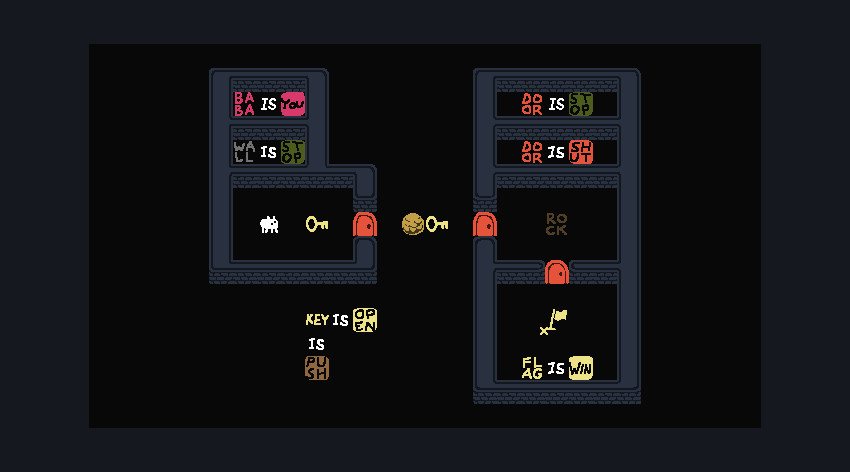
Breaking a rule
The simplest move is to push one word out of a sentence. If WALL IS STOP is blocking the way, push WALL, IS or STOP out of line and walls no longer block you. Many early levels are about finding which rule is in your way and which of its words you can reach.
Making your own win condition
If FLAG IS WIN is unreachable, maybe you can build a new sentence from loose words: ROCK IS WIN, WALL IS WIN, even BABA IS WIN. If something is both YOU and WIN at the same time, the level ends instantly, one of the first “aha” moments for most players.
Becoming something else
BABA IS YOU is just a sentence like any other. Form ROCK IS YOU and you control the rocks; make several things YOU and you move all of them together. Many levels are solved by swapping who you are to reach a spot Baba cannot get to.
Transformation
NOUN IS NOUN rules let you convert objects. If there is a flag you cannot reach but plenty of rocks nearby, ROCK IS FLAG may solve the problem. Transformation can also remove obstacles or create objects you need where they did not exist.
Vertical sentences and shared words
Rules can read downward as well as across, and a single word tile can belong to two sentences at once. Levels frequently hinge on noticing that a word placed for one rule also completes (or breaks) another at a right angle.
Thinking Like the Game: A Spoiler-Free Approach
Baba Is You can be very difficult, and later worlds contain puzzles that experienced players spend a long time on. A good process helps more than raw cleverness:
- Read every sentence on the screen. Before moving, list each active rule, then every loose word that is not part of a rule. The solution almost always uses something on that second list.
- Ask what is in the way. Is it a STOP rule, a DEFEAT object, a SINK hazard, a missing WIN, or a WIN object out of reach? Naming the obstacle narrows the options.
- Check which words you can physically reach. Text is always pushable, but walls, edges and other text can make a word impossible to move in the direction you need. Many levels are really about access to one particular tile.
- Consider pushing in every direction. A word that cannot go left may still be pushed down into a new vertical sentence.
- Read the level title. Level names are often hints, sometimes gentle and sometimes quite pointed.
- Look for the piece that seems unnecessary. Designers rarely include objects or words for decoration. If something appears to do nothing, it is likely the key.
Undo is unlimited and restarting is instant, so treat each attempt as a cheap experiment rather than planning everything in your head.
Common Mistakes and Misconceptions
Assuming the obvious goal is the real goal
Many levels place a flag in plain view with FLAG IS WIN already formed, but the flag is walled off. Players fixate on reaching it when the intended route is to change what WIN means. Conversely, some levels that look like rule-rewriting puzzles are really about movement and positioning.
Forgetting rules apply to everything at once
If you make WALL IS YOU, every wall moves when you press a direction. That can be a trap or the trick, because moving many objects simultaneously sometimes does what one object could not.
Destroying something you needed
SINK, DEFEAT and transformation rules can remove objects permanently. If you destroy the only text tile that could fix the level, you need to undo. When stuck, ask whether the level is still solvable from the current state.
Ignoring the edges
The screen border acts as a solid barrier. Text pushed against an edge cannot go further; some puzzles rely on that, while others punish it by trapping a word you need.
Treating a level as unsolvable
Every official level has a solution that follows the game’s consistent logic. If a solution seems to require something the rules do not allow, a property or interaction has usually not been fully understood yet. Revisit the level where it was introduced.
Getting Unstuck Without Spoiling the Game
The overworld usually lets you skip a stubborn level, and later areas open several paths at once. Coming back to a puzzle after solving others often helps, because you may have learned an interaction elsewhere that applies.
Further tactics:
- Write down the rules on paper. Listing active and possible sentences turns a visual jumble into a short set of options you can check one by one.
- Explain the level out loud. Describing what each word does, and why each attempt failed, frequently exposes a hidden assumption.
- Take a break. Solutions often arrive away from the screen, once you stop forcing the same failed approach.
- Ask for a nudge, not an answer. Ask friends for the smallest possible hint, such as “which word matters?”, rather than the full solution.
This way of learning overlaps with other puzzle games that teach through play rather than text. Our guide to approaching The Witness without spoilers covers a similar philosophy of rules that are shown rather than told.
Why the Design Works
At the most mechanical level, Baba Is You is a box-pushing puzzle in the Sokoban tradition: you move on a grid, push tiles and must avoid getting key pieces stuck in corners. What sets it apart is that the “boxes” are also the game’s code. Every push potentially rewrites how the world behaves.
A level can teach a new idea simply by placing a new word on the screen, and players learn its meaning by experimenting rather than reading a tutorial. Because the rules are always fully visible, a solution that clicks feels like discovering a loophole, earned rather than arbitrary.
Portal’s test chambers similarly introduce one element at a time and then combine them; Baba Is You does the same with words, except that the combinations are grammatical.
Frequently Asked Questions
Is Baba Is You suitable for beginners to puzzle games?
The opening levels are gentle and teach the basics well. Difficulty rises steeply later, and the full game is aimed at players who enjoy being stuck for a while.
Do you need to finish every level?
No. You can skip many levels and still move forward, and some areas are optional extras for completionists.
What platforms is it on?
As of 2026, it is available on Windows, macOS and Linux, Nintendo Switch, and Android and iOS, with custom levels shareable online through the Baba Make Level editor.
Is there a time limit or any reflex element?
No. The game is entirely turn-based: nothing moves unless you press a direction (or wait), and undo is unlimited.
How is it different from other rule-based puzzle games?
Many puzzle games have hidden rules you discover. Baba Is You puts the rules on screen as objects you manipulate, so the skill is seeing new consequences of rules you can already read.