Slay the Spire Ascension Levels Explained: What Each Step Adds
Every Slay the Spire Ascension level from 1 to 20 explained, how to unlock them, and how to adjust your strategy as elites, healing and bosses get harder.
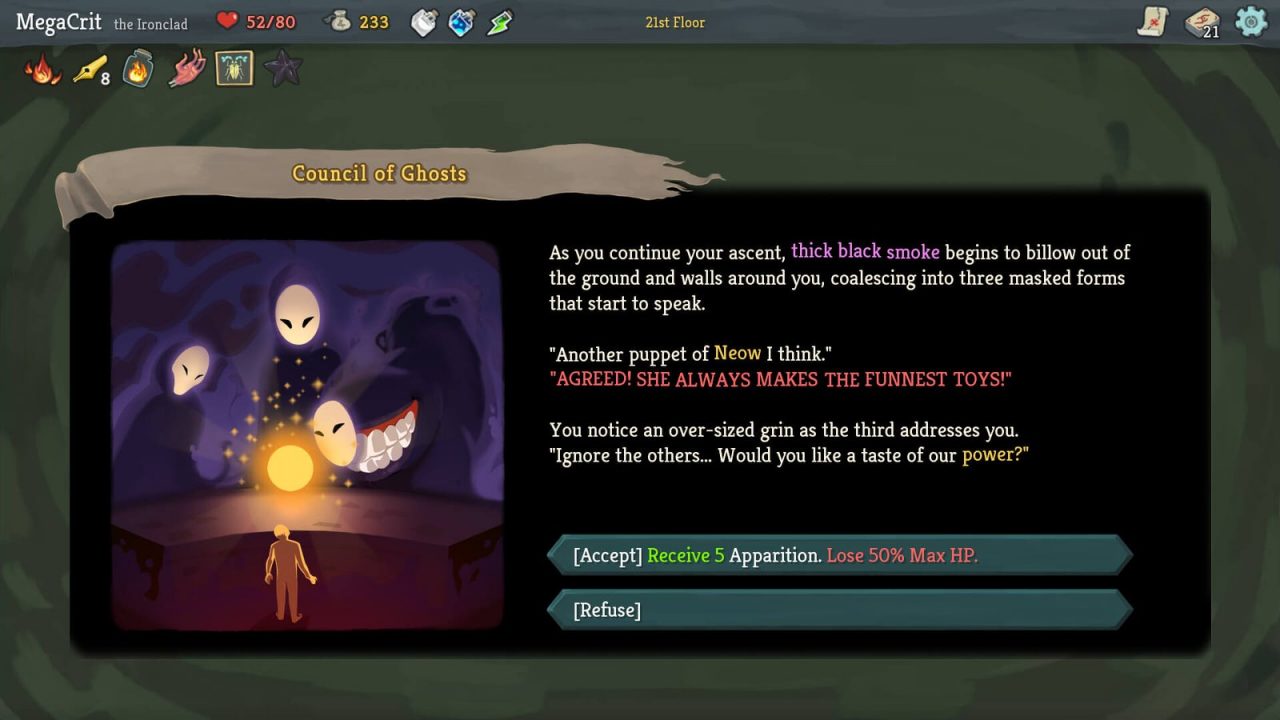
Beating Slay the Spire once is an achievement. Beating it consistently on the hardest settings is a different game altogether. That second game is the Ascension system: a ladder of twenty difficulty levels, each adding a new disadvantage on top of all the previous ones. By Ascension 20, the Spire is meaner in almost every way, with more elites, less healing, stronger enemies, weaker rewards and two bosses waiting at the end of Act 3.
This guide explains how Ascension works in the original Slay the Spire, lists what every level adds, and covers the strategic adjustments that matter as you climb. If you are still learning how a run works, our Slay the Spire beginner’s guide is the better starting point.
How Ascension Works and How to Unlock It
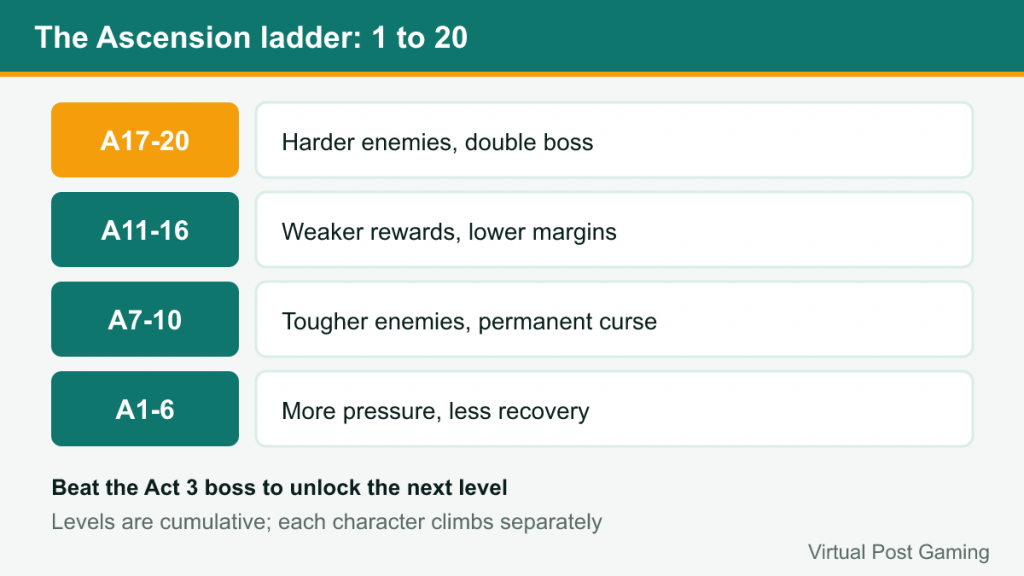
Ascension is a per-character difficulty setting. It unlocks for a character the first time you defeat an Act 3 boss with that character. From then on, you can toggle Ascension on when starting a run and choose a level.
The rules of progression are simple:
- Each level is unlocked by winning the previous one. Defeating the Act 3 boss on a given Ascension level unlocks the next one for that character.
- You do not need to beat the true final boss. Reaching Act 4 or defeating the Corrupt Heart is not required to progress; beating the Act 3 boss is enough.
- Each character climbs separately. Progress on the Ironclad does not unlock anything for the Silent, Defect or Watcher.
- Levels are cumulative. Ascension 10 includes everything from levels 1 to 9, plus its own modifier.
- You can always go back down. Any level you have unlocked can be selected, including lower ones.
The maximum is Ascension 20. Many players consider consistent wins at Ascension 20 a mark of real mastery of a character.
Levels 1 to 6: More Pressure, Less Recovery
The early levels raise the danger of fights and reduce your ability to recover between them.
| Level | Effect |
|---|---|
| 1 | Elites spawn more often on the map (roughly 60 percent more). |
| 2 | Normal enemies deal more damage. |
| 3 | Elites deal more damage. |
| 4 | Bosses deal more damage. |
| 5 | After a boss, you heal only 75 percent of your missing HP instead of all of it. |
| 6 | You start each run with 10 percent less HP. |
What changes in practice
Ascension 1 is interesting because more elites is both a threat and an opportunity. Elites drop relics, and relics are often what make a run, so the extra elites mean more rewards for decks strong enough to beat them. Levels 2 through 4 simply make every fight hurt more, which punishes decks that lack block.
Ascension 5 is the first level that changes how you manage resources across acts. In an unmodified game, beating a boss fully heals you. From A5 on, damage carries over partially, so ending Act 1 on low health makes Act 2 harder. Ascension 6 adds to that by starting you below full health, so the very first fights are a little riskier.
Levels 7 to 10: Tougher Enemies and a Permanent Curse
| Level | Effect |
|---|---|
| 7 | Normal enemies have more HP, and some gain more Block. |
| 8 | Elites have more HP, and some gain more Block. |
| 9 | Bosses have more HP, and some gain more Block. |
| 10 | You start each run with Ascender’s Bane in your deck. |
What changes in practice
Levels 7 to 9 lengthen fights. A deck that previously killed an elite in three turns may need a fourth, and that extra turn means more incoming damage. This is where frontloaded damage and scaling both become more important, because neither alone is enough for long, hard fights.
Ascension 10 introduces Ascender’s Bane, a curse that is Unplayable, Ethereal and cannot be removed from your deck. Because it is Ethereal, it exhausts at the end of your turn if it is in your hand, so it only clogs your draws until it exhausts in each combat. It is a modest nuisance on its own, but it permanently takes up a card slot, which makes card removal for your other weak cards more valuable.
Levels 11 to 16: Weaker Rewards and Lower Margins
| Level | Effect |
|---|---|
| 11 | You start with one fewer potion slot. |
| 12 | Upgraded cards appear half as often in rewards in Acts 2 and 3. |
| 13 | Bosses drop 25 percent less gold. |
| 14 | Max HP is reduced: by 5 for the Ironclad and by 4 for the Silent, Defect and Watcher. |
| 15 | Events have less positive outcomes and harsher consequences. |
| 16 | Everything in shops costs 10 percent more. |
What changes in practice
This block of levels is about economy. Fewer potion slots mean fewer emergency answers. Fewer upgraded rewards and less gold make the deck slightly weaker than it would otherwise be by the same point in a run. Higher shop prices make each card removal and relic purchase more expensive.
Ascension 14 deserves special attention because it permanently lowers your health ceiling. For the Silent, who already has the lowest starting HP, that reduction is especially felt. Ascension 15 changes the value of events: some that were reliably good become riskier, so players often become more selective about which question-mark rooms they visit and which options they accept.
Levels 17 to 20: Harder Enemies and the Double Boss
| Level | Effect |
|---|---|
| 17 | Normal enemies have more challenging movesets and abilities. |
| 18 | Elites have more challenging movesets and abilities. |
| 19 | Bosses have more challenging movesets and abilities. |
| 20 | You must fight two bosses at the end of Act 3. |
What changes in practice
Levels 17 to 19 are where experienced players feel the largest jump. Instead of only adding numbers, these levels change how enemies behave, giving them stronger patterns and abilities. Fights you had learned to handle with a particular plan may need a different one. Knowing each enemy’s patterns becomes much more important here than at low Ascension.
Ascension 20 ends Act 3 with two boss fights in a row. Your deck must be able to win a long boss fight and then immediately do it again, which places a premium on consistency, healing management and scaling that does not fall apart in a second fight.
Strategic Adjustments as You Climb
Plan for more elites
Because elites appear more often from A1, map routing becomes a bigger decision. A strong deck can path through elites for relics; a weak one must avoid them. Early in Act 1, many players aim to build enough damage to fight an elite safely before choosing a path that includes several.
Value defense more highly
Higher enemy damage at A2 to A4 and longer fights from A7 to A9 make block, weakening effects and damage prevention more valuable than at low Ascension. Decks that relied on killing everything quickly at A0 often fail once enemies have more health.
Protect your health between acts
Partial boss healing from A5 means HP is a resource across the whole run, not just per act. Rest sites become more important, and the choice between resting and upgrading a card tilts toward resting more often.
Treat card removal as a priority
With Ascender’s Bane in every deck from A10 and higher shop prices from A16, the value of removing basic Strikes and Defends grows. Our guide to drafting in roguelike deckbuilders explains why a leaner deck is usually stronger.
Prepare for two bosses
At A20, think about the end of Act 3 from the middle of Act 2. Ask whether your deck can survive two full boss fights and whether your scaling works twice. Potions saved for the final fights become very valuable.
A Sensible Path Up the Ladder
- Start with a character you know well. Learning a character and learning higher difficulties at the same time is harder than doing one at a time.
- Expect plateaus. Most players hit walls at specific levels, often around A5 and A10 and again at A17 to A20, where the changes alter strategy rather than just numbers.
- Review losses. After a failed run, note what ended it: a specific elite, lack of damage, poor healing management. Patterns appear quickly.
- Do not be afraid to drop down. If a level feels impossible, playing a lower level to practice a new approach is perfectly reasonable.
Common Mistakes at Higher Ascension
Greedy pathing
Choosing every elite because relics are valuable can end a run in Act 1. Count your HP and your deck’s real damage before committing.
Skipping rest sites for upgrades
Upgrades help, but arriving at a boss on low health with partial healing afterward can doom the next act.
Ignoring enemy patterns
At A17 to A19 enemies behave differently. Strategies memorized at lower levels may fail without adaptation.
Assuming the sequel works the same
This guide covers the original game. Slay the Spire 2, which entered early access in March 2026, has its own systems and content, so check how it handles difficulty before applying these numbers to it. Our Slay the Spire 2 explainer covers what is different.
Frequently Asked Questions
Do I need to beat the Heart to unlock the next Ascension level?
No. Defeating the Act 3 boss on a given level is enough to unlock the next level for that character. Reaching Act 4 is a separate challenge.
Which character is easiest to climb with?
It depends on your style. The Ironclad’s higher HP and end-of-combat healing from its starting relic give some margin for error, which many players find helpful as damage and elite counts rise. The Silent’s lower HP makes the health reductions at A6 and A14 more noticeable.
Can I lose progress?
No. Unlocked levels stay unlocked. Losing a run at a given level simply means you try that level again; you can also select any lower level you have already unlocked.
Are the modifiers shown in the game?
Yes. When you select an Ascension level at the start of a run, the game describes that level’s modifier, and all lower modifiers apply as well.