Board Game Arena Explained: How to Play Board Games in Your Browser
How Board Game Arena works: free and premium access, real-time vs turn-based tables, Elo and Arena mode, licensed games, tutorials and table etiquette.

Board Game Arena, usually shortened to BGA, is the closest thing the hobby has to a public library of board games you can play online. It runs in a web browser, it hosts officially licensed versions of hundreds of modern and classic games, and the computer enforces every rule so nobody needs to read the manual aloud. You can sit down at a quick real-time table with strangers, or start a slow game with friends that unfolds over a week of short turns.
This guide explains how the platform works, from creating a table to understanding ratings, plus the etiquette that keeps games pleasant. Features and catalog details change over time, so the descriptions below reflect the platform’s general setup as of 2026 rather than specific counts or prices.
What Board Game Arena Is and Who Runs It
BGA was founded in France in 2010 by Grégory Isabelli and Emmanuel Colin. It grew steadily for a decade and then exploded in popularity in 2020, when many groups who could not meet in person moved their game nights online.
In February 2021 Asmodee, one of the largest board game publishers and distributors, announced that it had acquired the platform. Asmodee said at the time that BGA would continue to operate with its existing management and remain open to games from other publishers, not only Asmodee titles. That openness matters: the catalog includes games from many different companies, from small independent publishers to major ones.
The key point for players is that games on BGA are licensed. The platform works with publishers to put official adaptations online, which is why some popular games are absent and why titles occasionally arrive in beta before a full release.
Getting Started: Accounts, Free Play and Premium
Creating an account is free, and a free account can play a large share of the catalog. Many games can be started and joined at no cost, and the platform runs in any modern browser on desktop computers, tablets and phones.
BGA also offers a paid Premium membership. In general terms, Premium unlocks extra benefits such as the ability to start tables of games marked as premium, along with various quality-of-life features. A practical detail worth knowing is that free players can typically join a premium game if someone with Premium creates the table, so one subscriber in a friend group can often host for everyone. Because the exact list of perks and the price are revised from time to time, check the Premium page on the site itself rather than relying on a third-party summary.
When you first log in, it is worth spending a minute on settings: language, time zone and notification preferences. Notifications matter especially for turn-based games, since you will want an alert when it is your move.
Real-Time vs Turn-Based Tables
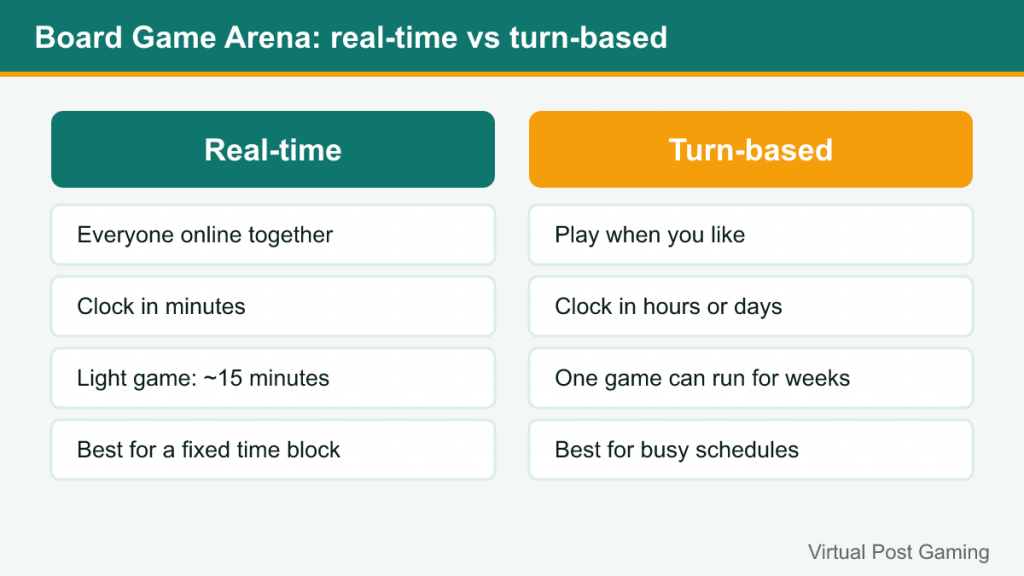
Every game on BGA is played in one of two broad modes, and choosing the right one shapes the whole experience.
Real-time
In real-time play, everyone is online together and each player has a game clock measured in minutes. This feels closest to a game night: a light game finishes in a quarter of an hour, a heavier one in an hour or two. Real-time tables are ideal when you have a fixed block of time, especially with friends on voice chat.
Turn-based
Turn-based play, sometimes called asynchronous play, gives each player a much longer allowance per move, measured in hours or days. Players do not need to be online at the same time; you log in, take your turn and leave. A single game may run for days or weeks. This mode suits busy schedules, players in different time zones and long strategy games where thinking time is welcome.
The clock and why it matters
Both modes use a clock. If a player runs out of time, opponents can usually choose to skip that player’s turns or end the game, and the slow player may be penalized. The clock exists to stop abandoned games from stalling everyone else. If you know you will be away, the decent thing is to warn the other players or avoid starting new turn-based games until you are back.
Finding and Learning Games
The game catalog can be browsed by popularity, novelty, player count, complexity and play time. Each game page shows basic information, the rules summary and links to tutorials or help pages.
Learning tools vary by title. Many games have an interactive tutorial that walks you through a sample turn, and some have a rules reference built into the interface with tooltips that explain cards and spaces when you hover over them. The platform also has a training mode for many games, where you can play without affecting your rating.
A good way to start is to pick a few light, well-known games first. Gateway titles and classic abstract games have large player bases, so tables fill quickly and opponents are used to newcomers. Once you are comfortable with the interface, move on to heavier titles. If you want a sense of which games translate well to screens in general, our overview of the best digital board game adaptations covers the qualities that make a good digital version.
Beta and alpha games
New implementations often launch in beta. They are playable but may still have bugs or missing features. Many players enjoy trying them early, but it is wise to expect occasional problems and to report bugs through the official channels rather than arguing about them at the table.
Ratings: Elo, Levels and Arena Mode
BGA tracks a separate skill rating for each game, based on the Elo system originally designed for chess. In simple terms, you gain points by finishing above other players and lose points by finishing below them, and the amount depends on the gap between your rating and theirs. Beating a much stronger player earns a lot; losing to a much weaker player costs a lot.
A few consequences follow from how it works:
- Placement counts in multiplayer games. In a four-player game, finishing second rather than fourth still helps your rating, so it is worth playing out a game you cannot win.
- Abandoning is costly. Quitting a game is treated harshly in rating terms, and it also affects how other players see you.
- Training mode protects your rating. If you are learning a game, play unrated or in training so mistakes do not count.
Beyond regular ratings, BGA offers an Arena mode for players who want structured competition. Arena runs in seasons of three months, with players climbing through leagues in a specific game and earning recognition at the end of each season. It is entirely optional: you can play BGA for years in normal mode and never touch it.
Reputation, Friends and Groups
BGA tracks reliability as well as skill. Players who regularly abandon games, run out of time or behave badly see that reflected in their reputation, and table creators can restrict who may join based on it. For most players this works in their favor, because it filters out people likely to disappear halfway through a game.
The social tools are straightforward. You can add friends, create groups for a regular game circle, invite specific people to a table and chat in-game. Many clubs and online communities use groups to run their own leagues and tournaments. The platform also supports official tournaments, which are organized events with set formats and schedules.
Table Etiquette
Because BGA enforces the rules, most friction comes from behavior rather than disagreements about how to play. A few habits make you a welcome opponent:
- Read the table options before joining. Check whether a table is real-time or turn-based, the speed setting and any rating restrictions. Joining a fast real-time game when you only have five minutes is a recipe for abandoning it.
- Say if you are new. Many tables are happy to welcome learners, but it is courteous to mention it, especially in competitive settings.
- Play your turns promptly. In turn-based games, try to move at least once a day. Long silences are the most common complaint on the platform.
- Do not quit when losing. Finishing a lost game respects the other players’ time and protects your own reputation.
- Keep chat friendly. A quick greeting and “good game” at the end go a long way. If someone is rude, use the platform’s reporting and blocking tools rather than escalating.
Strengths and Limitations
| Strength | Limitation |
|---|---|
| Runs in a browser on almost any device | Interfaces are functional rather than lavish compared with standalone apps |
| Large licensed catalog in one place | Some popular games are not available because of licensing |
| Rules enforced automatically | Beta implementations may contain bugs |
| Turn-based play suits busy schedules | Async games depend on everyone taking turns regularly |
| Free tier is generous | Some games and features require Premium |
Compared with standalone apps, BGA trades presentation for breadth. A dedicated adaptation may have animations, music and a polished single-player campaign, while BGA offers a consistent, simple interface across a huge range of games and makes it easy for a group to try something new every week.
Compared with physics sandboxes, where players move virtual pieces by hand and enforce rules themselves, BGA is far less flexible but far easier: you never need to set up a board or explain a rule, and nobody can accidentally knock the pieces over.
Frequently Asked Questions
Do I need to install anything?
No. BGA runs in a modern web browser, including mobile browsers, so there is nothing to download to start playing.
Can I play against the computer?
BGA is primarily built for playing against other people. Some games include solo modes when the board game itself has one, but if you mainly want AI opponents, a standalone digital edition is usually a better fit.
Is it a good place to learn a new game?
Yes, especially in training or unrated tables. Because the interface shows only legal moves, it is an efficient way to understand a game before buying the physical copy.
Can I add my own games?
BGA has a developer program called BGA Studio, through which volunteer developers build new implementations. Games are published only with the rights holder’s permission, so it is not a place to upload unlicensed versions.