Types of Puzzle Games: A Field Guide from Falling Blocks to Rule-Breakers
A field guide to puzzle game subgenres, from falling blocks and match-3 to logic grids, box-pushing, physics, spatial, programming and rule-breaking puzzles.
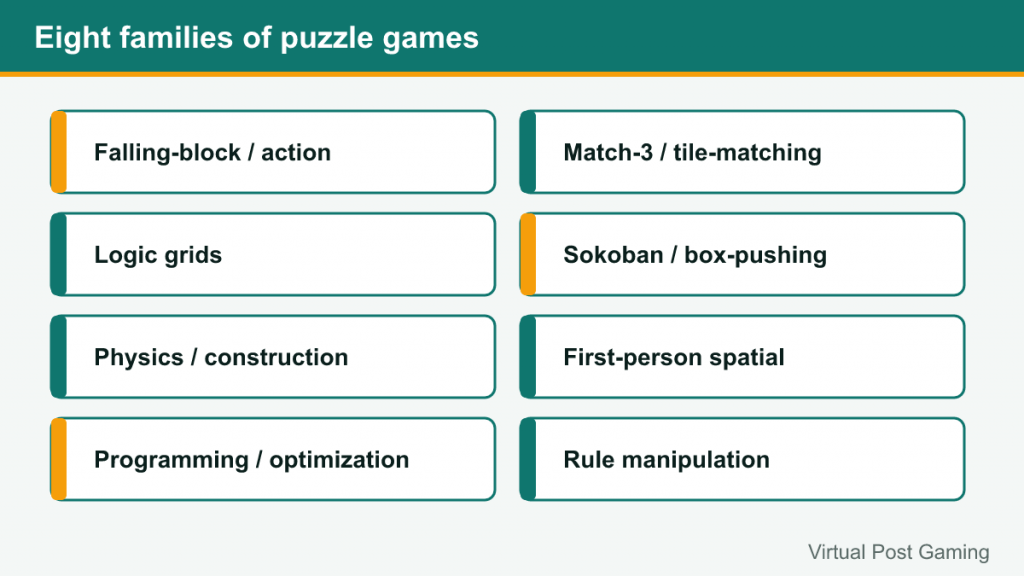
“Puzzle game” covers an enormous amount of ground. The label fits a frantic round of Tetris and a quiet afternoon with a grid of numbers, a box-pushing level that takes an hour to crack and a physics toy where you build a wobbly bridge out of planks. These games share one thing: the main challenge is mental rather than about reflexes, stats or story. Beyond that, they differ in how they create problems and what kind of thinking they reward.
This field guide sorts the genre into its major families, explains what makes each one tick, and names a landmark example or two so you know where to start. The categories overlap constantly, and many great games belong to two at once, but knowing the families makes it far easier to find more of what you already enjoy.
Why Classify Puzzle Games at All?
Two players can both say they “love puzzle games” and have almost nothing in common. One wants a fast, replayable test of pattern recognition under pressure. The other wants a handcrafted set of levels, each with a single clever solution. Recommendations go wrong when those two tastes get mixed up.
A useful way to split the genre is by asking three questions:
- Is there time pressure? Action puzzles add a clock or falling pieces; pure logic puzzles wait for you indefinitely.
- Are the levels designed or generated? Handcrafted puzzles have intended solutions. Endless or procedurally generated games reward general skill instead.
- Is there one answer or many? Classic logic puzzles have exactly one solution. Optimization and physics puzzles accept many and let you judge how well you solved them.
Keep those questions in mind as you read the families below.
Falling-Block and Action Puzzles
Action puzzle games combine spatial thinking with time pressure. Pieces arrive continuously, the board fills up, and you must clear space faster than it fills. There is no single solution; there is only playing well or less well, which is why these games are endlessly replayable.
Landmark examples
- Tetris (1984), created by Alexey Pajitnov, is the founding text. Seven shapes, line clears and steadily rising speed remain the template more than four decades later. Modern versions added the hold piece, a preview queue and the 7-bag randomizer, covered in our guide to how modern Tetris works.
- Puyo Puyo (1991), from Compile, swapped line clears for colored blobs that pop in groups of four. Its chain system, where one clear causes the next, made it a deep competitive game in Japan.
Other notable members of the family include Sega’s Columns (1990), the vertical-swapping Panel de Pon (1995, released in the West as Tetris Attack) and Lumines (2004), which tied clearing to a music-driven timeline sweep.
What skill looks like
Action puzzles reward pattern recognition that becomes automatic with practice: you stop thinking about where a piece fits and simply see it. Advanced play is about planning several pieces ahead and building setups that pay off later, such as stacking for a four-line clear or a long Puyo chain.
Match-3 and Tile-Matching
Tile-matching games ask you to swap, slide or select pieces to form groups of identical tiles, which then disappear. The family overlaps with action puzzles, but many match-3 games are turn-based, so the challenge shifts from speed to choosing the best move on a static board.
The best-known PC example is Bejeweled from PopCap Games, which arrived in the early 2000s and popularized the swap-two-adjacent-gems formula. Earlier tile-matching designs exist, such as the 1985 game Chain Shot!, and the family later became dominant on phones, but the core idea has stayed the same: spot matches, set up cascades, and plan for the pieces that fall in after a clear.
Logic Grids: Sudoku, Nonograms and Friends
Logic grid puzzles are the purest form of deduction. Each puzzle has exactly one solution that can be reached by reasoning alone, without guessing. The digital versions are often faithful translations of pen-and-paper puzzles, with conveniences like automatic error checking, undo and note-taking.
- Sudoku-style number placement asks you to fill a grid so each row, column and box contains each digit once. The Japanese publisher Nikoli gave the puzzle its famous name and popularized it in the 1980s.
- Nonograms, also called Picross or paint-by-numbers, use number clues along each row and column to reveal a hidden picture. They were devised in Japan in 1987, and Nintendo’s Mario’s Picross (1995) introduced many players to them on handheld consoles.
- Other grid logic includes Minesweeper-style mine deduction, Kakuro sums and the hundreds of puzzle types collected in apps and puzzle books.
These games teach a habit that transfers everywhere: only commit to a cell when you can prove it. Experienced solvers learn standard techniques, such as the overlap method in nonograms or candidate elimination in Sudoku, and spend most of their time finding where those techniques apply.
Sokoban and Box-Pushing Puzzles
Sokoban, released in Japan in 1982, gave its name to a whole family: you walk around a grid, you can push (but never pull) boxes, and you must get every box onto a target square. The rules fit in one sentence, yet the puzzles can be fiendish because pushing a box into a corner or against a wall can leave the level impossible to finish. Players call these positions deadlocks.
The family has had a remarkable modern revival. Notable descendants include:
- Stephen’s Sausage Roll (2016) by Increpare, famous for a difficulty curve that starts high and keeps climbing.
- Snakebird (2015), where the “boxes” are your own bodies, affected by gravity.
- A Monster’s Expedition (2020) by Draknek, built around pushing trees to form bridges across an open world of islands.
- Patrick’s Parabox (2022), in which boxes can contain whole levels that you can push yourself into, recursively.
Rule-manipulation games, covered below, also tend to sit on a box-pushing grid, which shows how flexible the format is.
Physics and Construction Puzzles
Physics puzzles hand you a simulated world and a goal, then let the simulation decide whether your idea works. There is rarely one correct answer; there are many contraptions that succeed and many more that collapse.
- The Incredible Machine (1993) asked players to build Rube Goldberg chains from ropes, balloons, conveyor belts and cats to accomplish simple tasks.
- World of Goo (2008) by 2D Boy turned tower and bridge building with sticky goo balls into a charming, often tense balancing act.
- Bridge-building games such as Poly Bridge (2016) ask you to span gaps on a budget, testing structural intuition.
Construction puzzles reward experimentation more than deduction. The fastest way to improve is usually to build something, watch exactly how it fails and fix that weak point, rather than trying to design a perfect solution on the first attempt.
First-Person Spatial Puzzles
When puzzles move into three dimensions and a first-person camera, perception and movement become part of the challenge. You navigate rooms, manipulate objects and often exploit an unusual rule about space itself.
Valve’s Portal (2007) is the defining example: linked openings on two surfaces let you redirect yourself, objects and momentum. Its sequel expanded the toolset with light bridges, lasers and gels, all explained in our guide to Portal’s puzzles.
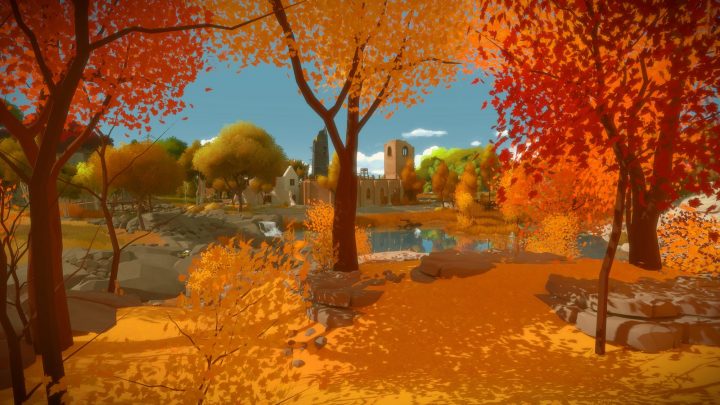
Other important titles each build around a different spatial idea. The Talos Principle (2014) by Croteam uses tools like jammers, connectors and recorders across open puzzle areas. Antichamber (2013) plays with non-Euclidean spaces where corridors do not connect the way they should. Superliminal (2019) makes objects as big as they appear from your viewpoint. Manifold Garden (2019) lets you change which surface counts as the floor in a world that repeats infinitely. The Witness (2016) also belongs nearby: although its puzzles are drawn on panels, finding and reading them depends on exploring a three-dimensional island.
Programming and Optimization Puzzles
Programming puzzles ask you to build a machine, write a small program or lay out a factory that transforms inputs into outputs. They differ from most puzzle types in two ways: the solution space is wide open, and after you succeed the game measures how efficiently you did it.
The idea goes back to educational software such as Rocky’s Boots (1982), but the modern form was shaped largely by Zachtronics. SpaceChem (2011) had players route molecules through reactors, Infinifactory (2015) moved factory design into 3D, TIS-100 (2015) used a fictional assembly language, and Opus Magnum (2017) built alchemical machines with moving arms. Tomorrow Corporation’s Human Resource Machine (2015) is a gentler introduction that teaches real programming concepts through office workers shuttling boxes.
Many of these games show histograms comparing your solution with everyone else’s on metrics like cost, speed and size. That turns a solved puzzle into an invitation to go back and do better, which is why fans often spend more time optimizing than solving.
Rule-Manipulation Puzzles
The newest and perhaps most mind-bending family lets you change the rules of the puzzle itself. Instead of discovering a fixed system, you rewrite it.
Baba Is You (2019) by Arvi Teikari is the signature game here. Rules such as WALL IS STOP sit on the floor as pushable word tiles, so solving a level often means editing what the level means. Our Baba Is You explainer covers how its rule blocks work.
The common thread in this family is self-reference: the game’s logic is part of the board. These puzzles appeal most to players who enjoy finding loopholes, and they tend to produce the strongest “aha” moments, because the solution usually involves seeing an ordinary rule from a completely new angle.
Hybrids and Edge Cases
Plenty of games combine families. Tetris Effect places a classic falling-block game inside a sound-and-light show. Patrick’s Parabox merges box-pushing with recursion that feels close to rule-bending. Opus Magnum’s machines are programs, but building them feels like spatial construction. Puzzle elements also appear in nearly every other genre, from dungeons in adventure games to card combinations in deckbuilders.
A few kinds of game are often filed nearby but usually work better under a different label. Story-led adventure games with inventory puzzles, detective games built around deduction of a mystery, and horror games with lock-and-key rooms all contain puzzles, but players typically choose them for narrative or atmosphere. Likewise, games that use puzzle mechanics mainly as a wrapper for a progression or spending system are a different experience from a designed puzzle game.
Choosing Your Next Puzzle Game
Use the family that you already enjoy as a starting point, then branch into neighbors:
| If you like… | Try next… | Why |
|---|---|---|
| Tetris or Puyo Puyo | Lumines, Panel de Pon | Same pressure, different clearing rules |
| Sudoku and nonograms | Handcrafted Sokoban games | Pure deduction with a single solution |
| Sokoban | Baba Is You, Patrick’s Parabox | Grid pushing with a twist on the rules |
| Portal | The Talos Principle, Superliminal | First-person tools and spatial tricks |
| Physics builders | Programming puzzles like Opus Magnum | Open-ended building plus optimization |
For short sessions, action puzzles and logic grids work best; for long, focused sessions, handcrafted box-pushing, spatial and rule-manipulation games deliver more.
Frequently Asked Questions
Is a puzzle game the same as a “brain training” game?
Not quite. Brain-training software packages short exercises as self-improvement; puzzle games are designed as entertainment first.
Which family is best for beginners?
Falling-block and match-3 games have the smallest learning curve. Among handcrafted puzzle games, Portal and the early levels of Baba Is You are known for teaching their ideas gently before ramping up.